
Electronics Basics · Embedded Systems · Microcontrollers
Microcontroller Working Principle: 5 Essential Facts Every Engineer Should Know
A single microcontroller no bigger than a fingernail contains an entire computer, processor, memory, and input/output all included. This guide explains the microcontroller working principle in depth, with an original block diagram, a real world execution walkthrough, and a video.
What is Microcontroller?
A microcontroller is a complete, small computer built onto a single chip. That single chip fact is the entire distinction that matters. A general purpose microprocessor, the kind found in a desktop computer, needs separate external chips for memory and input/output before it can do anything useful. A microcontroller already has all of that built in, ready to run a dedicated task the moment power is applied.
This is exactly why microcontrollers show up everywhere a device needs to sense something and react to it, from a smart thermostat to a microcontroller based instrument correcting a thermocouple reading, without needing a full operating system or a stack of external chips.
5 Facts About How a Microcontroller Actually Works
Together, these five facts make up the core microcontroller working principle that applies across nearly every chip on the market.
What is Inside microcontroller Chip
This diagram is the visual core of the microcontroller working principle, showing every essential block on one chip.
Block Diagram of Microcontroller
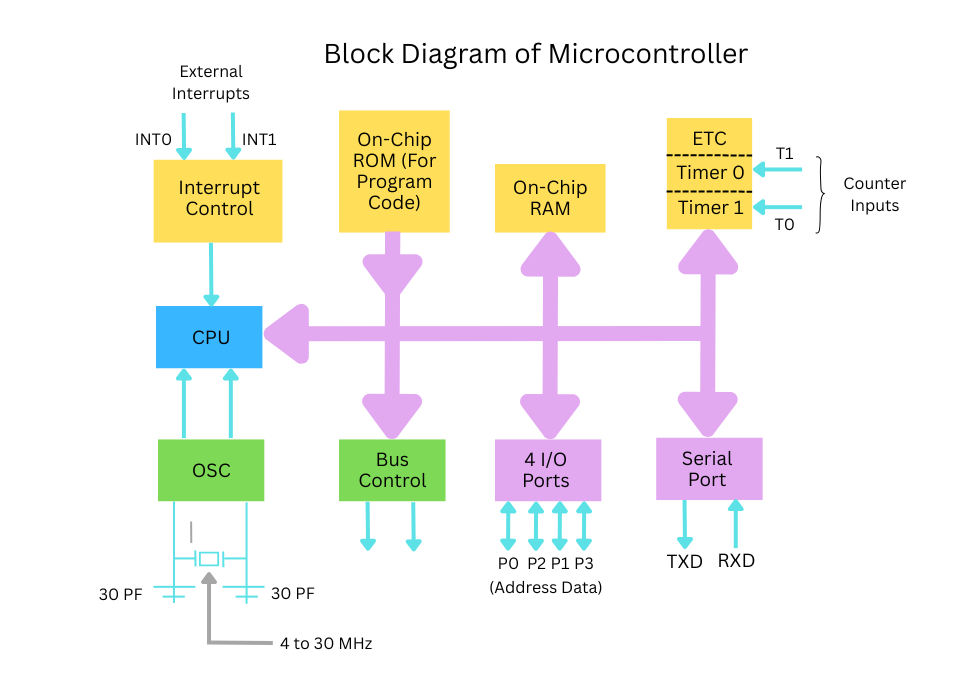
The diagram above groups related functions together to keep things readable, but each block inside a real microcontroller has its own distinct job. Here is what each one actually does.
| Block | What It Actually Does |
|---|---|
| CPU | Fetches, decodes, and executes program instructions, and performs the arithmetic and logic operations the program calls for. |
| Control Unit | Works alongside the CPU specifically to decode each instruction and direct the correct sequence of operations to carry it out, effectively coordinating traffic between every other block during execution. |
| RAM | Holds variables and working data only while the program is actively running, and loses that data completely the moment power is removed. |
| ROM / Flash | Stores the actual program code permanently, surviving power loss, though on most modern chips this is reprogrammable flash memory rather than true one time ROM. |
| I/O Ports | Provide the physical pins that read incoming signals from switches and sensors, and send outgoing signals to drive things like LEDs, relays, or motors. |
| Timers and Counters | Track elapsed time for delays and scheduled events, or count external pulses, entirely independent of whatever the main program is doing at that moment. |
| Communication Interfaces | Dedicated hardware such as UART, SPI, and I2C handle the detailed timing of talking to other chips, freeing the CPU from managing that timing manually. |
| ADC | Samples a continuously varying analog voltage, from a sensor for example, and converts it into a digital number the CPU can actually work with. |
| DAC | Performs the reverse conversion, turning a digital value back into a smooth analog voltage, useful for audio output or analog control signals. |
| Clock Circuit | Generates the steady timing pulse that paces every operation on the chip, and its frequency largely sets how fast the microcontroller can execute instructions. |
| Bus System | The data bus physically carries information between blocks, while the address bus specifies exactly which memory location or peripheral that information is headed to or coming from. |
| Interrupt Controller | Watches for priority events and, when one occurs, pauses the CPU's current task cleanly so a time sensitive response can run immediately, then hands control back to the interrupted task afterward. |
The exact mix and organization of these blocks differs from one microcontroller family to the next, but this same basic set defines the microcontroller working principle across the vast majority of chips in use today.
What Happens From Power On to Output
Watch: What Is a Microcontroller and How Does It Work?
This beginner friendly video explains microcontroller basics with clear, practical examples.
Microcontroller vs Microprocessor
This distinction is the most common source of confusion when people first learn the microcontroller working principle.
| Feature | Microcontroller | Microprocessor |
|---|---|---|
| Memory and I/O | Built into the same chip | Requires separate external chips |
| Typical role | Dedicated task in an embedded system | General purpose computing |
| Power consumption | Generally lower | Generally higher |
| Cost and complexity | Lower, self contained | Higher, needs supporting circuitry |
A Real Example: The 8051 Microcontroller
Concrete specifications make the abstract blocks above easier to picture. The 8051, one of the most widely taught microcontrollers, breaks down like this.
| Component | 8051 Specification |
|---|---|
| Program memory (ROM) | 4 KB internal |
| Data memory (RAM) | 128 bytes internal |
| Address bus | 16 bit |
| Data bus | 8 bit |
| Timers | Two, 16 bit each |
| Serial port | Full duplex UART |
Where Microcontrollers are used?
Digital transmitters use onboard microcontrollers for compensation and signal processing.
Engine, braking, and safety systems each rely on dedicated microcontrollers.
Washing machines, thermostats, and coffee makers run on simple, low cost microcontrollers.
Motor control, sensor fusion, and real time decision making all run on embedded microcontrollers.
Low power microcontrollers sense conditions and report data over wireless links.
Smart sensors digitize and condition signals internally before sending data onward.
Quick FAQs: Microcontroller Working Principle
These are the questions people ask most often once the basic microcontroller working principle meets a real embedded project.
External References
- Electronics For You: Microcontroller Basics
- GeeksforGeeks: 8051 Microcontroller Architecture
- Wikipedia: Microcontroller
What we learn today
- The microcontroller working principle centers on integrating CPU, memory, and I/O onto a single chip, ready to run a dedicated task immediately.
- ROM or Flash stores the program permanently, while RAM handles temporary data during execution, each serving a distinct purpose.
- Every microcontroller follows the same basic execution pattern: power on, boot, initialize hardware, run the main loop, and handle interrupts as they occur.
- This single chip integration is exactly what makes microcontrollers the practical choice for embedded tasks, from home appliances to industrial smart sensors.