
Electronics Basics · Semiconductors · Digital Systems
Microprocessor and Integrated Circuit: 4 Key Differences Every Engineer Should Know
Every microprocessor is an integrated circuit, but plenty of integrated circuits are not microprocessors at all. This guide untangles microprocessor and integrated circuit terminology properly, with an original category diagram, real comparison tables, and clear guidance on which term applies where.
Microprocessor and Integrated Circuit: What's the Real Difference?
These two terms get used almost interchangeably in casual conversation, and that habit causes real confusion in technical discussions. The short answer: every microprocessor is an integrated circuit, but the reverse is not true. The two sections below define each term on its own, followed by how they actually relate to each other.
What Is an Integrated Circuit (IC)?
An integrated circuit is a small electronic device that packs many interconnected components, transistors, capacitors, and resistors, onto a single piece of semiconductor material. Unlike a microprocessor, most integrated circuits are built to perform one specific function or a narrow set of related functions, not a broad, changeable range of tasks.
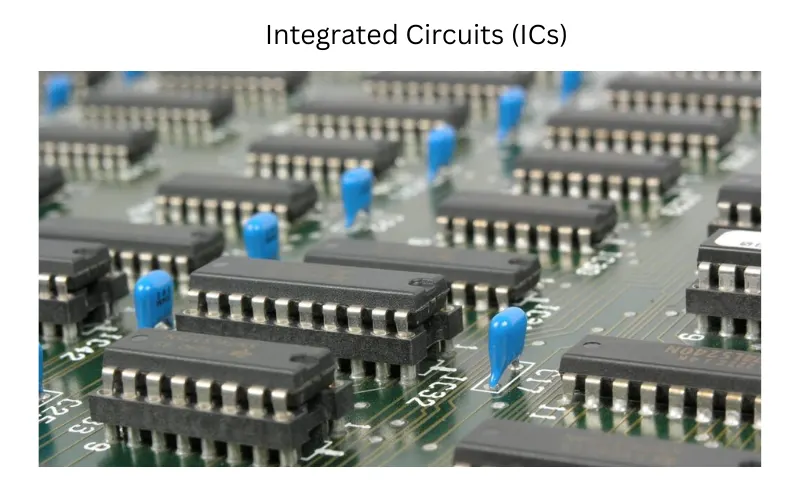
Integrated circuits fall into three main categories, based on the kind of signal they are designed to handle.
| IC Type | What It Handles | Typical Example |
|---|---|---|
| Analog IC | Continuous, smoothly varying signals | Amplifiers, voltage regulators |
| Digital IC | Discrete on/off logic signals | Logic gates, microcontrollers, microprocessors |
| Mixed Signal IC | Both analog and digital functions together | Communication and radio frequency circuits |
What Is a Microprocessor?
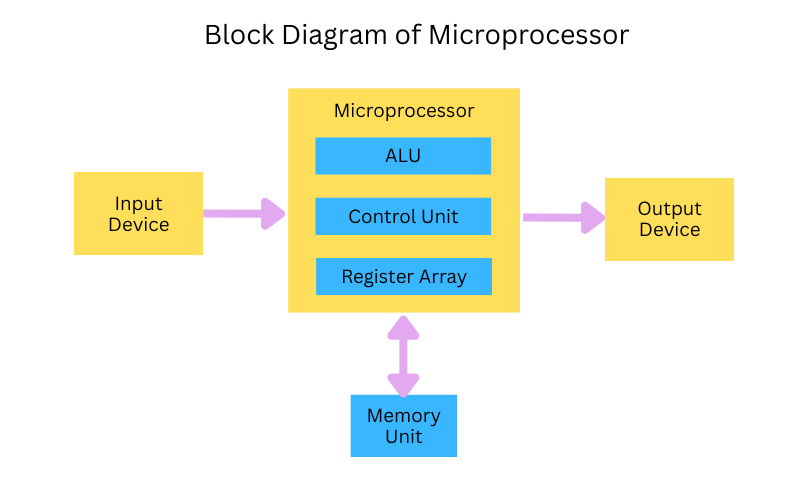
A microprocessor is a chip built to execute software instructions, effectively acting as the processing brain inside a computer or embedded device. It reads a program, works through calculations, and directs data between the other parts of a system. Three properties define what makes a microprocessor distinct from other chips.
- Programmable: it can be reprogrammed to perform many different functions, not just one fixed task.
- Versatile: it interacts with a wide variety of other hardware and software components.
- Capable of multitasking: modern multi core designs can handle several operations at once.
A microprocessor is, technically speaking, a digital integrated circuit, just one built specifically for programmable computation rather than a single fixed job.
Microprocessor Block Diagram
Watch: What Is a Microprocessor?
This short video explains how a microprocessor fits inside the broader integrated circuit category.
Video: "What is a Microprocessor? (in just 3 mins)", embedded via YouTube
The 4 Key Differences Between Microprocessor and Integrated Circuit
Microprocessor vs Integrated Circuit Comparison Table
This table captures the practical distinctions that actually matter when selecting between the two for a component.
| Feature | Microprocessor | Integrated Circuit (General) |
|---|---|---|
| Primary function | Executes software instructions and controls system data flow | Performs one specific function, such as logic, amplification, or memory |
| Complexity | High, deliberately programmable | Generally lower, purpose built for one task |
| Flexibility | Highly flexible across many tasks | Limited to its designed function |
| Typical cost | Higher, reflecting added complexity | Generally lower for simpler, single purpose designs |
Applications of Microprocessor and Integrated Circuit
Where Microprocessors Are Used
Microprocessors form the core processing unit of virtually every PC.
Microprocessors manage engine control and infotainment functions.
Smart TVs and digital cameras rely on microprocessors for programmable control.
Where Integrated Circuits Are Used
Flash drives and RAM modules use dedicated integrated circuits, not microprocessors.
Wireless communication devices rely on specialized mixed signal integrated circuits.
Voltage regulators and power distribution units use dedicated analog integrated circuits.
Quick FAQs: Microprocessor and Integrated Circuit
These are the questions engineers ask most often once they start comparing the two options for a real design.
External References
What we learn today
- Integrated circuit is the broad manufacturing category, any chip combining multiple components, while microprocessor names one specific, programmable type within that category.
- A microprocessor prioritizes flexibility and programmability, while most other ICs prioritize efficiency at one fixed task.
- Analog, digital, and mixed signal are the three main IC categories, with microprocessors falling under the digital IC umbrella.
- Choosing between them comes down to whether the application needs broad programmability or a simple, efficient, fixed function.