
Scotch Yoke vs Rack & Pinion Pneumatic Actuator: Torque Curve Comparison
A stuck valve doesn't need steady force. It needs a hard, deliberate kick right at the moment it's stuck. That single design philosophy is the entire reason two different actuator geometries still compete for the same job.
Scotch yoke and rack and pinion actuators both convert linear piston motion into the rotary output that quarter-turn valves need, but they produce fundamentally different torque profiles across the stroke. This guide compares both mechanisms, their torque curves, and a clear selection framework based on the valve you're actually automating.
Scotch Yoke vs Rack and Pinion Pneumatic Actuator: Introduction
A rack and pinion actuator uses two pistons with rack teeth that engage a central pinion gear. As the pistons move outward under air pressure, the pinion rotates, producing a torque output that stays relatively constant across the full 0 to 90 degree stroke, since the gear teeth remain the same distance from the center of rotation throughout.
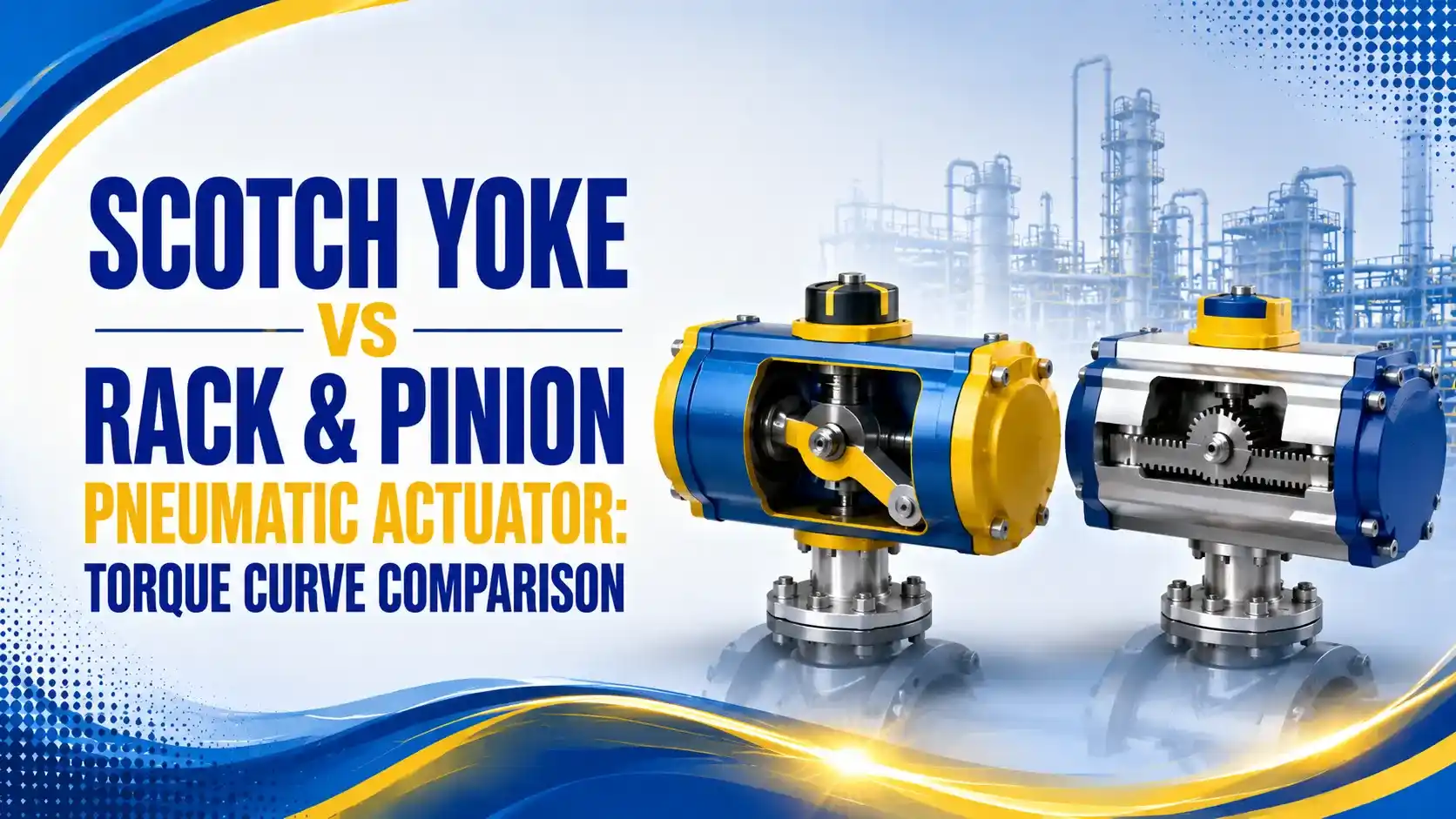
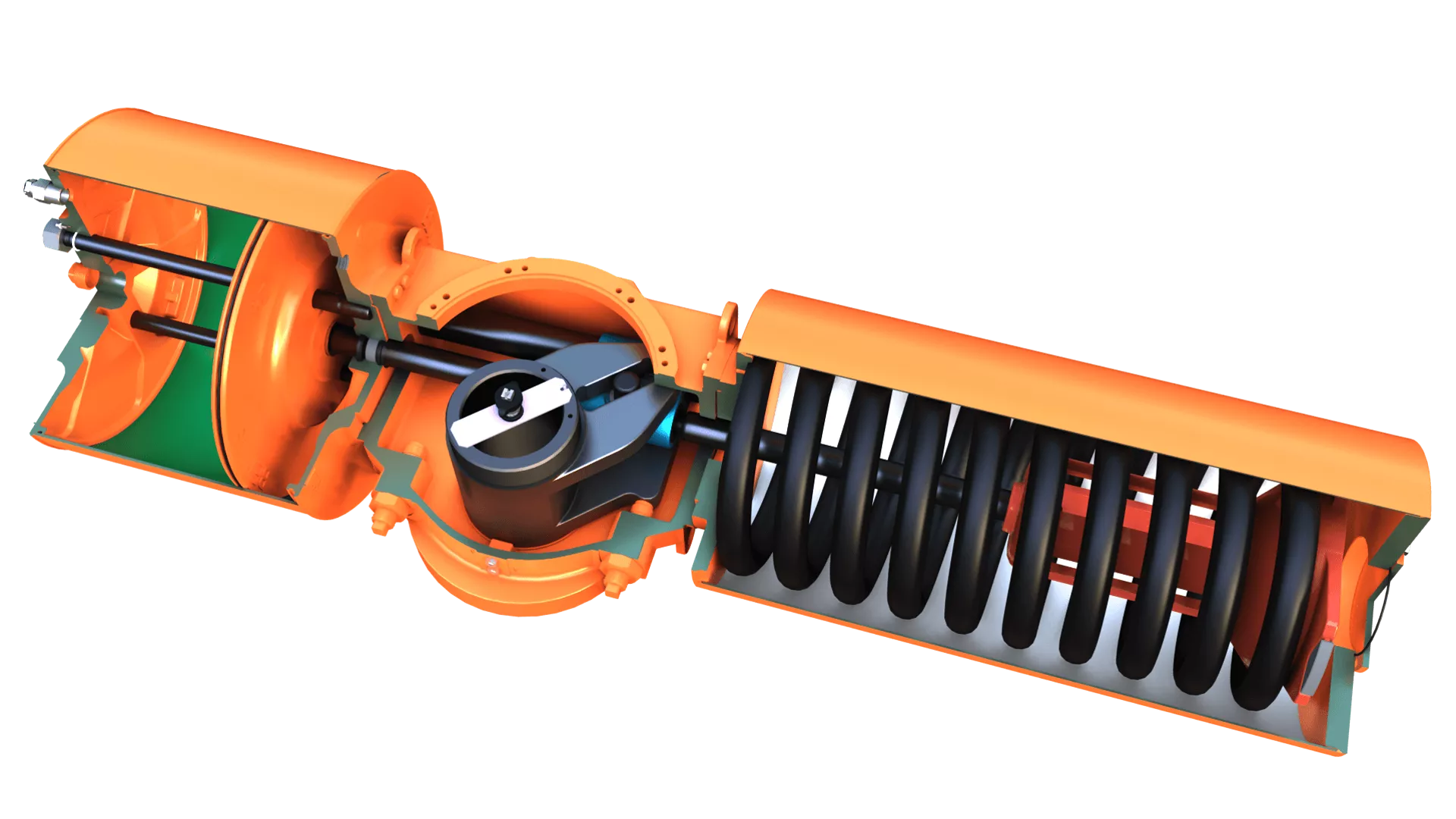
A scotch yoke actuator instead uses a piston rod connected to a sliding block riding inside a transverse slot on a rotating yoke. As the yoke rotates, the effective moment arm between the piston force and the rotation axis continuously changes, producing a torque curve that peaks sharply at the start and end of the stroke and dips in the middle.
This difference in torque shape isn't a minor engineering detail, it's the entire basis for choosing between them. Many valve actuation decisions ultimately come down to matching the actuator's torque curve against the valve's own resistance curve at every point in the stroke.
Real Life Example
Think of a rack and pinion actuator like pedaling a bicycle with perfectly round gears: your leg delivers roughly the same push throughout each pedal stroke. A scotch yoke actuator is more like a hand-cranked well pump: right at the very top and bottom of the crank's rotation, you naturally get extra mechanical leverage, and that's precisely where you need the biggest push to overcome the pump's resistance at those points. Valves with sticky, metal-to-metal seats behave the same way, needing a big kick right at breakaway, which is exactly what the scotch yoke's geometry naturally delivers without wasting any extra air pressure elsewhere in the stroke.
Torque Curve Comparison
Rack and pinion delivers a flat torque line across the stroke. Scotch yoke delivers peak torque at both the start (breakaway) and end (final seating) of the 90° rotation, dipping in the middle where the valve needs the least force.
The Scotch Yoke Torque Formula
The scotch yoke's non-constant torque output isn't a side effect, it's the direct, calculable result of its geometry. As the crank angle θ moves away from the mid-stroke centerline, the effective moment arm changes according to a cosine relationship, which is why the resulting torque curve takes its characteristic U-shape. A commonly used simplified formula for scotch yoke output torque is:
Torque(θ) = (P × A × R × efficiency) / cos(θ)
P = supply pressure · A = piston area · R = moment arm (crank radius) · efficiency = mechanical efficiency, typically 0.85–0.95 · θ = yoke angle from center stroke
In practice, this means torque is lowest when the yoke sits perpendicular to the piston rod, at mid-stroke, and rises toward both ends of the 90° travel. Manufacturers also offer two distinct yoke geometries to fine-tune this curve for different valve types: a symmetric yoke, which delivers maximum torque equally at both the 0° and 90° positions, well suited to ball valves, and a canted (tilted) yoke, which concentrates maximum torque only at the end of the stroke, better suited to butterfly valves that mainly need extra force during final seating.
Scotch Yoke: Video Walkthrough
Scotch Yoke vs Rack & Pinion
⚙️ Rack & Pinion
Two pistons drive a rack that rotates a central pinion. Constant torque output, compact and lightweight, faster cycle times, and easily field-convertible between double-acting and spring-return. The industry workhorse for small to medium quarter-turn valves.
🔄 Scotch Yoke
A piston-driven sliding block rides in a slot on a rotating yoke. U-shaped torque curve with high breakaway and reseating force, higher overall torque density for large valves, and fewer wearing gear teeth to jam or backlash over time.
Comparison Table
Sizing With a Safety Factor
Matching an actuator to a valve's peak torque exactly, with zero margin, is a common and risky mistake, since seat friction only increases with age, temperature, and corrosion.
Clean Water / Air Service
Low-risk, well-maintained, frequently cycled valves
ESD / Safety Valves
Valves idle for months, needing a guaranteed hard "kick" to break stiction on demand
This is exactly where the scotch yoke's high breakaway torque earns its reputation: a valve idle for six months, exposed to scale and corrosion, needs that mechanical kick at 0° far more than steady mid-stroke torque.
Common Failure Modes
Rack & Pinion: Gear Backlash
Millions of duty cycles wear down gear teeth, introducing "play." Tolerable for on/off duty, but a real problem for precise throttling where small positioner signals need small, repeatable moves.
Scotch Yoke: Pin/Slot Wear
The sliding block or roller bearing wears into the yoke slot under continuous load if under-lubricated, gradually increasing clearance. Simpler geometry overall means better tolerance of dusty or contaminated air.
Cycle Time and Stroke Speed
RACK & PINION
Faster cycling from lower moving mass; strong fit for sub-1-second ESD response
SCOTCH YOKE
Larger/heavier components cycle slower, but sustain high counts long-term with hardened pins and lubrication
For high-frequency cycling (>10 cycles/min), rack and pinion is typically preferred. For infrequent, high-torque, high-reliability duty, the scotch yoke's durability advantage outweighs its modest speed disadvantage.
Applications
Trunnion Ball Valves
High seat friction at rest favors scotch yoke's peak breakaway torque.
Butterfly Valves (Small)
Constant torque demand makes rack and pinion the common choice under 12 inches.
Emergency Shutdown Valves
Scotch yoke's mechanical "kick" reliably breaks stiction after months idle.
Modulating Control Valves
Rack and pinion's linear torque suits continuous 4-20 mA throttling duty.
Plug Valves
High seating/unseating torque favors scotch yoke, especially at larger sizes.
Large Pipeline Isolation
Above roughly 1,000 Nm, scotch yoke wins decisively on size and cost.
Frequently Asked Questions
- JIMAI, Rack and Pinion vs Scotch Yoke Pneumatic Actuator
- Hearken Valve, Scotch Yoke vs Rack and Pinion: Choosing the Right Actuator
- Valworx, Scotch Yoke vs Rack and Pinion Actuators: What's the Difference?
What We Learn Today
- Rack and pinion actuators deliver constant torque across the stroke; scotch yoke actuators deliver a U-shaped curve
- Scotch yoke's peak breakaway torque, roughly 20% higher, suits valves with high seat friction at rest
- Rack and pinion's steady torque suits modulating control and smaller valve sizes needing precise throttling
- Above roughly 1,000 Nm, scotch yoke becomes the more compact and cost-effective choice
- Always overlay actual valve and actuator torque curves; sizing on a single peak number risks under-torquing