
ISA-88 Batch Control Explained: Recipes, Phases, and the Physical Model
Separate the recipe from the wiring, and a formula change stops meaning a PLC rewrite. That single idea is what ISA-88 gave the batch process industry.
ISA-88 defines how batch processes should be modeled, separating the physical equipment from the recipe that runs on it. This guide explains the physical model, procedural model, and recipe hierarchy, with a worked reactor example.
What is ISA-88?
ISA-88, also known as S88, is a standard developed by the International Society of Automation and adopted internationally as IEC 61512-1. It is not a piece of software or a specific vendor product. It is a design philosophy and set of models for structuring batch process automation, first approved in 1995 and updated in 2010.
Before S88, every batch automation project reinvented its own terminology and structure, making it difficult for engineers to communicate requirements, and nearly impossible to reuse control logic when a formula changed. S88 solved this by separating what a process should do (the recipe) from how the physical equipment is wired and driven (the equipment modules and PLC logic underneath it).
Real Life Example
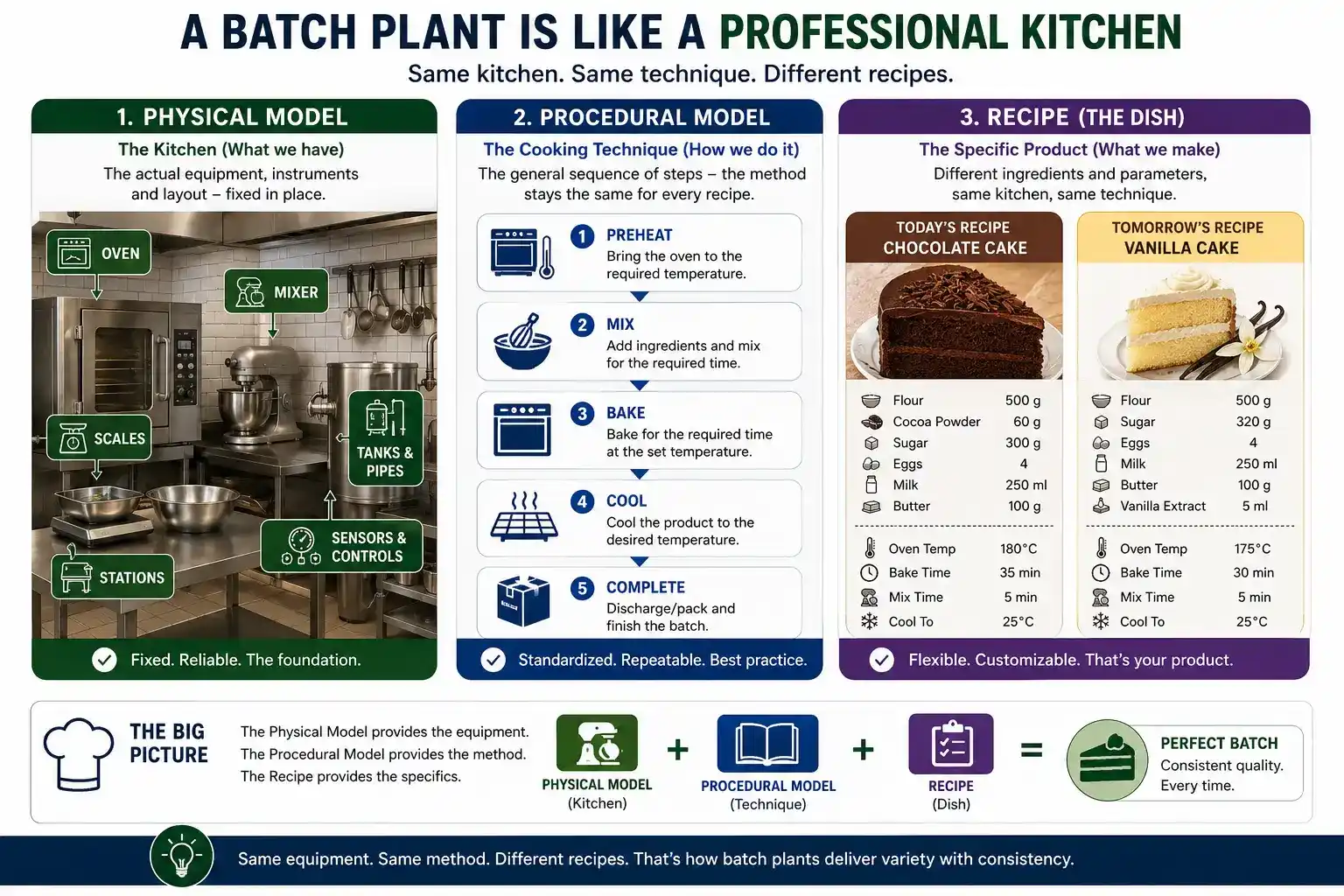
Think of a batch plant like a professional kitchen. The Physical Model is the kitchen itself: the ovens, mixers, and stations, fixed in place. The Procedural Model is the general cooking technique: preheat, mix, bake, cool, in that order, regardless of what's being made. The Recipe is the specific dish: today it's chocolate cake, tomorrow it's vanilla, using the exact same ovens and the exact same general technique, just with different ingredients and parameters plugged in.
The Physical Model: Equipment Hierarchy
The Physical Model describes the equipment itself, arranged as a strict hierarchy from the entire enterprise down to individual control devices. Lower levels are combined to form the level above them.
The top three levels, Enterprise, Site, and Area, are considered business layers and are not further described by the standard. The lower four levels, Process Cell, Unit, Equipment Module, and Control Module, are what the batch process automation itself actually operates on.
The Procedural Model and Recipe Model
📋 Procedural Model
Defines the generic instructions used to run a batch, structured top-down:
- Procedure: The overall strategy for the entire batch
- Unit Procedure: Steps carried out within one specific Unit
- Operation: A major processing step, like heating or mixing
- Phase: The smallest independent action, like opening a valve
📖 Recipe Model
Defines four recipe types with increasing specificity:
- General Recipe: Enterprise-wide, equipment-independent formula
- Site Recipe: Adapted for a specific site's terminology and units
- Master Recipe: Adapted to a specific process cell's actual equipment
- Control Recipe: The exact instance executed for one specific batch
A Phase in the Procedural Model corresponds directly to an Equipment Module in the Physical Model. When a recipe calls a phase, that phase passes parameters to the equipment module it is bound to, which then executes the actual control logic already programmed into the PLC or DCS.
Worked Example: A Three-Unit Batch Train
Applications of ISA-88
Pharmaceutical Manufacturing
S88 recipes support validated, auditable batch records required by regulatory review.
Chemical Processing
Reactor, filter, and dryer trains reuse the same equipment modules across many products.
Food and Beverage
Recipe management lets a plant switch products without reprogramming control logic.
Specialty Chemicals
Master recipes adapt a general formula to whichever process cell is available.
MES Integration
ISA-95 treats S88 batch systems as Level 2, feeding data up to MES and ERP layers.
Biotech and Fermentation
Phases and equipment modules manage sterile transfer and fermentation sequencing reliably.
Common ISA-88 Implementation Mistakes
✅ Do This
- Keep the recipe and the equipment logic genuinely separate, not just named differently
- Design phases as small, reusable, parameter-driven units
- Maintain a clear physical model hierarchy before writing any procedural logic
- Govern recipe changes through formal change control, not ad hoc edits
❌ Avoid This
- Hardcoding recipe-specific values directly into PLC ladder logic
- Building monolithic phases that try to do too much in one call
- Skipping the site and master recipe adaptation steps for a new process cell
- Treating S88 as software rather than a structuring philosophy for the whole batch process
ISA-88 Batch Control: Video Walkthrough
Frequently Asked Questions About ISA-88
- Wikipedia, ISA-88
- PLC Academy, ISA-88 (S88) Batch Control Explained
- eTech Group, An Introduction and Guide to the S88 Batch Control Standard
What We Learn Today
- ISA-88 is a design philosophy, not software, separating batch recipes from equipment control logic
- The Physical Model runs from Enterprise down to Control Module in a strict hierarchy
- The Procedural Model breaks a batch into Procedure, Unit Procedure, Operation, and Phase
- Four recipe types, general, site, master, and control, adapt one formula across sites and equipment
- Keeping recipes and equipment logic genuinely separate is what lets a formula change without a PLC rewrite