
A machine that unexpectedly restarts during maintenance is one of the most preventable causes of serious injury on a plant floor. Lockout tagout exists to make that restart physically impossible until the work is done, and getting it right depends on details most training slides gloss over.
Lockout tagout, often shortened to LOTO, is the safety procedure that keeps hazardous energy from suddenly returning while someone has their hands inside a machine. It sounds simple on paper. In practice, it is one of the most heavily regulated procedures in industry for a good reason.
Without lockout tagout, a technician clearing a jam or replacing a part has no guarantee the equipment will stay off. A breaker gets bumped, a valve gets reopened, stored energy releases on its own, and routine maintenance turns into a serious injury in seconds.
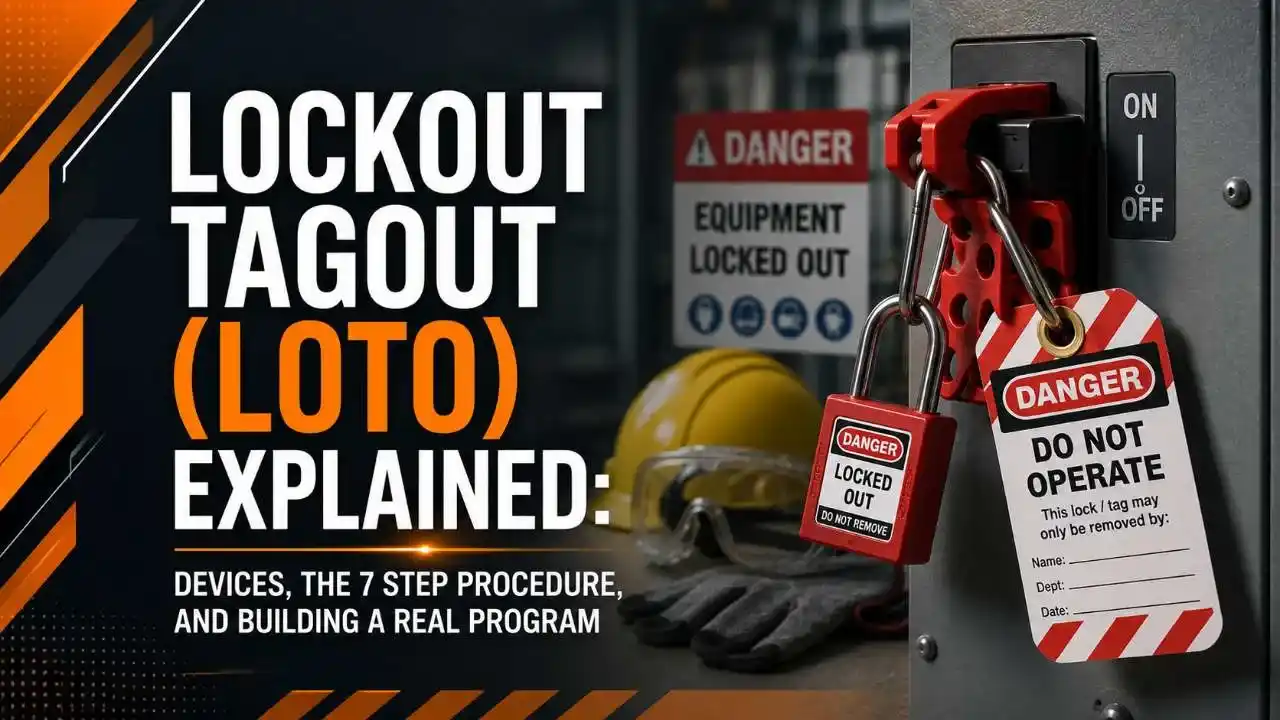
This guide covers what lockout tagout actually means, the devices involved, the full 7 step procedure, and what it takes to build a lockout tagout program that holds up under a real audit.
What Is Lockout Tagout
Lockout tagout is a safety procedure that protects workers from unexpected exposure to hazardous energy while equipment is being serviced or repaired. A lockout device, usually a padlock, physically holds an energy isolating device in the off position. A tagout device, a prominent tag, warns everyone nearby that the equipment must not be operated.
Without a proper LOTO procedure, workers face real risk of serious injury or death from an unexpected machine startup or the sudden release of stored energy, whether that energy is electrical, mechanical, hydraulic, pneumatic, or thermal.
Why Lockout Tagout Matters
The release of hazardous energy during maintenance is one of the most common causes of serious workplace injury. A properly applied LOTO procedure isolates the equipment from every energy source before anyone reaches inside it, cutting that risk dramatically.
A strong LOTO program also reduces costly equipment damage, extends the working life of machinery, and keeps a facility on the right side of occupational safety regulations. Just as importantly, it builds a culture where workers expect hazardous energy to be controlled, not assumed to be safe.
Lockout Tagout Standards
In the United States, the OSHA lockout tagout standard, 1910.147, applies to any activity where the sudden startup or energization of equipment could injure a worker. A separate standard, 1910.212, covers machine guarding during normal production.
The distinction matters in practice. The lockout tagout standard takes over from machine guarding whenever a worker has to bypass or remove a guard, or whenever sudden energization during the task could cause injury.
The moment a task requires removing a guard or reaching into a point of operation, you are no longer in machine guarding territory. That is exactly when lockout tagout becomes mandatory, not optional.
Types of Lockout Tagout Devices
OSHA requires every lockout tagout device to be durable, standardized, substantial, and identifiable, and none of them can be reused once retired. Four distinct device types make up a complete lockout tagout program.
Energy Isolating Device
The physical point that actually isolates energy, such as a breaker, valve, or disconnect. Push buttons and selector switches do not count as energy isolating devices.
Lockout Device
A padlock, blank flange, or bolted slip blind that physically holds the energy isolating device in a safe position. Employer issued padlocks must be standardized and used for lockout purposes only.
Tagout Device
A prominent tag fastened to the energy isolating device, warning that the equipment must not be operated. Tags typically identify who applied the lockout and why.
LOTO Box
Also called a lockbox or group lockout box, used when equipment has several isolation points that each need their own lock before the whole system can be safely worked on.

The 7 Steps of Lockout Tagout Procedure
Preparation
The authorized employee identifies the equipment or process to be shut down, the energy sources that need to be controlled, and every hazard that comes with them.
Notification
Every affected worker is told what is being locked out, why, how long it should take, who the authorized person is, and who to contact with questions.
Shutdown
The equipment is shut down following the manufacturer's or workplace's established procedure, with all controls turned off and moving parts brought to a full stop.
Isolation
The authorized person disconnects the equipment from every energy source it is connected to, whether that means opening a breaker or closing a valve.
Dissipation
Any residual energy still stored in the equipment gets disconnected, restrained, relieved, or otherwise made non hazardous before work continues.
Lockout and Tagout
The equipment is physically locked using the energy isolating devices, and a tag identifying who applied the lockout is attached alongside it.
Isolation Verification
Every step is rechecked, and the process is tested by attempting to activate the controls. If nothing happens, isolation is confirmed complete.
Watch: Lockout Tagout Explained
This walkthrough from Master Lock, a longstanding manufacturer of lockout devices, covers the same fundamentals with real equipment on screen.
Video: "Master Lock OSHA Lockout Tagout", via YouTube.
Building a Real LOTO Program
An OSHA compliant lockout tagout program rests on three core components working together, not just a written policy sitting in a binder.
LOTO Inspections
Periodic inspections confirm that equipment is properly locked and tagged before maintenance begins, catching gaps before an accidental energy release can happen.
LOTO Training
| Employee Type | Training Focus |
|---|---|
| Authorized employees | Hazardous energy sources, the type and magnitude of that energy, and methods for isolation and control |
| Affected employees | The purpose and use of lockout tagout procedures at the site |
| Other nearby employees | The rule that locked out equipment must never be restarted, regardless of the reason |
Sustained LOTO Safety
✔ Do
- Clearly define and communicate the LOTO policy sitewide
- Create a simple system for submitting and reviewing LOTO reports
- Run frequent LOTO audits, not just annual ones
- Keep LOTO documentation current and accessible
✘ Don't
- Treat LOTO training as a one time onboarding checkbox
- Allow personal, unstandardized locks to be used for lockout
- Skip isolation verification because the job feels routine
- Let a LOTO tag stay on equipment without a name and reason
FAQs on Lockout Tagout
You May Also Like
What Is SIL (Safety Integrity Level)?
SIL is a number from 1 to 4 that shows up on instrument datasheets, HAZOP reports, and safety system specifications, and it tells you how reliable a safety function needs to be. This beginner friendly guide explains what a Safety Instrumented System and a Safety Instrumented Function actually are, how the required SIL is determined, and what it means for the instruments you specify and maintain.
Read Full Article →What we learn today
- Lockout tagout protects workers by physically locking equipment off and tagging it as a warning during maintenance.
- OSHA 1910.147 governs lockout tagout, while 1910.212 covers machine guarding during normal production.
- A complete lockout tagout program uses four device types: energy isolating devices, lockout devices, tagout devices, and LOTO boxes for group lockout.
- The 7 step procedure runs from preparation through isolation verification, and skipping the last step is one of the most common real world failures.
- A lasting lockout tagout program needs regular inspections, tiered training, and consistent enforcement, not just a written policy.