
Servo Motor vs Stepper Motor: Key Differences and Selection Guide
One moves blind and trusts every pulse landed correctly. The other checks its own position constantly and corrects itself in real time. Neither is universally better, and picking wrong shows up immediately on the machine floor.
Servo motors and stepper motors both deliver precise, controlled motion, but they achieve it through fundamentally different control philosophies. This guide compares open-loop versus closed-loop operation, torque-speed behavior, cost, and where each motor actually belongs on your machine.
What is the Difference Between a Servo and a Stepper Motor?
A stepper motor converts electrical pulses directly into discrete angular steps, moving to a commanded position without ever confirming it actually arrived there. A servo motor pairs a motor with a feedback device, typically an encoder or resolver, continuously comparing actual position against the commanded position and correcting any error in real time. That single distinction, open-loop versus closed-loop control, is the root cause of nearly every other difference between the two technologies.
Both motor types show up constantly in industrial automation, robotics, and precision instrumentation, anywhere accurate, controlled motion matters more than the simple continuous rotation a standard AC or DC motor provides.
Real Life Example
Think of a stepper motor like someone walking blindfolded, counting out exactly twenty steps forward because they were told twenty steps would reach the door. If the floor is uneven or something blocks one step, they may end up in the wrong place with no way of knowing. A servo motor is like someone walking toward that same door with their eyes open, constantly checking their actual position and adjusting stride the whole way, arriving exactly at the door regardless of an uneven floor along the way.
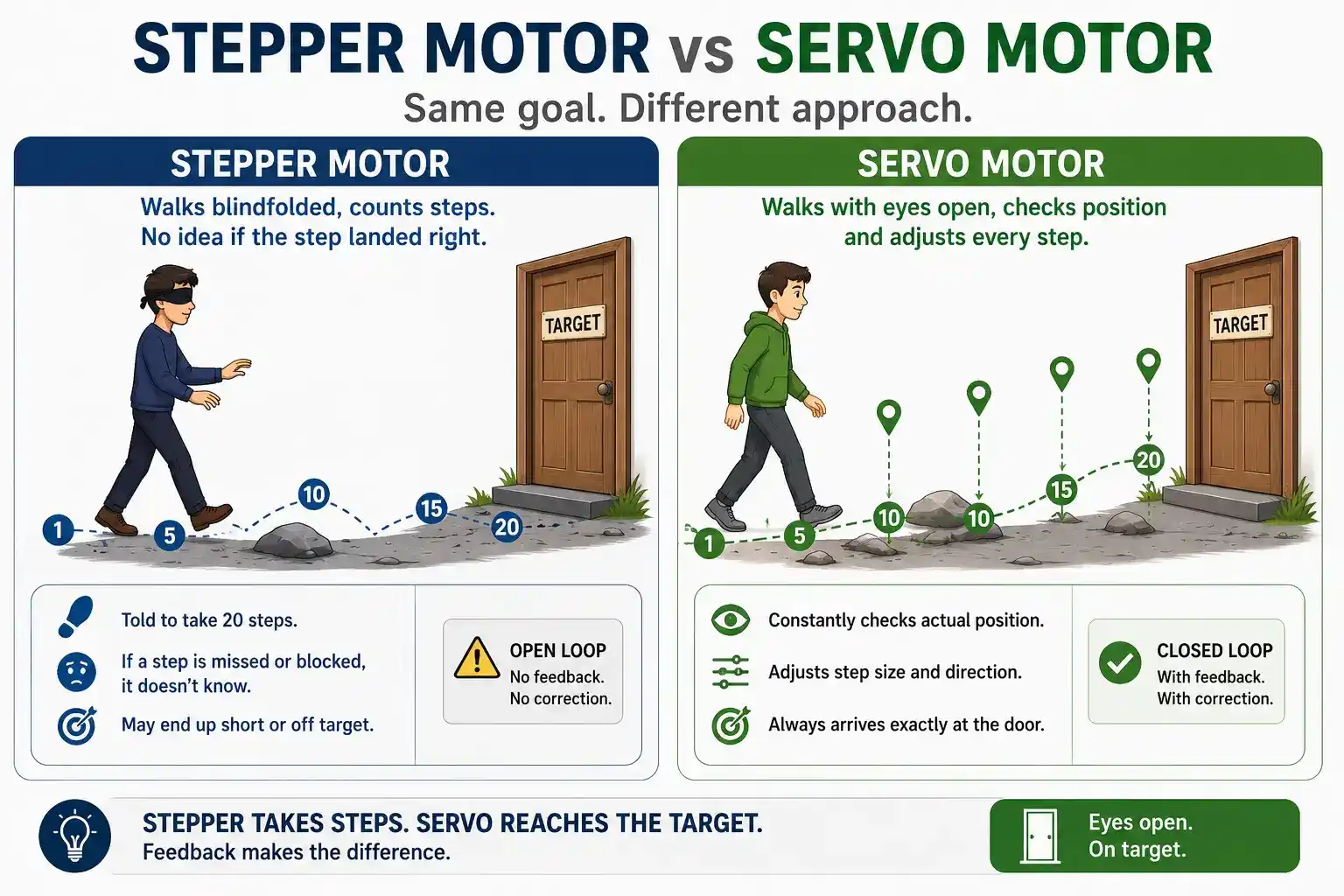
Servo Motor vs Stepper Motor: Core Differences
🔄 Stepper Motor
⚙️ Servo Motor
Comparison Table
Which Motor Should You Choose?
| Application Requirement | Recommended Motor |
|---|---|
| 3D printers, low-cost CNC axes | Stepper Motor |
| Laboratory automation, simple positioning | Stepper Motor |
| Robotics and pick-and-place systems | Servo Motor |
| High-speed packaging and conveyor lines | Servo Motor |
| Applications needing tool holding at standstill | Stepper Motor |
| Precise torque or force control (pressing, twisting) | Servo Motor |
| Cost-sensitive, low-speed, low-accuracy tasks | Stepper Motor |
| Continuous motion at variable, high loads | Servo Motor |
Applications
3D Printing
Stepper motors handle precise, repeatable axis movement at modest speeds cost-effectively.
Robotic Arms
Servo motors provide the speed, torque, and accuracy needed for articulating robot joints.
CNC Machining
Servo motors dominate high-precision, high-speed CNC spindle and axis control.
Packaging Lines
Servo motors handle high-speed, variable-load packaging and converting equipment.
Laboratory Instruments
Stepper motors provide reliable, low-cost positioning for scientific equipment.
Automotive Assembly
Servo motors deliver the precise torque control needed for pressing and fastening operations.
Common Selection Mistakes
✅ Do This
- Check the full torque-speed curve, not just the motor's rated torque number
- Choose servo motors when speed, accuracy, and variable load handling all matter together
- Choose stepper motors for simple, cost-sensitive, low-speed positioning tasks
- Add an encoder to a stepper motor if verified position feedback becomes important later
❌ Avoid This
- Assuming a stepper motor with a gearbox solves a fundamentally high-speed application
- Ignoring that a stepper motor can silently lose steps under excessive load with no feedback to catch it
- Overspending on a servo system for a simple, predictable, low-load positioning task
- Forgetting that servo systems require tuning and more complex drive electronics
Servo Motor vs Stepper Motor: Video Walkthrough
Frequently Asked Questions
- Control.com, Servo Motor vs Stepper Motor: Understanding the Differences
- Machine Design, Stepper and Servo Motor Tradeoffs
- AMCI, Tutorial: Stepper vs Servo
What We Learn Today
- Stepper motors run open-loop, servo motors run closed-loop with continuous feedback correction
- Steppers deliver strong torque and holding force at low speed, servos maintain consistent torque across a wider speed range
- Servo motors offer better accuracy and higher top speed, at greater cost and control complexity
- Steppers can silently lose steps under excessive load, while servo feedback actively corrects position errors
- Matching the motor to actual speed, torque, and accuracy requirements matters more than defaulting to whichever seems more advanced