
Electrical Basics · Motor Control · Power Electronics
VFD Working Principle: How a Drive Actually Controls Motor Speed
A VFD never actually generates a new frequency directly from the wall supply, it destroys the incoming AC entirely and rebuilds a brand new waveform from scratch. This guide covers the VFD working principle in depth, with an original block diagram, real formulas, a live energy savings calculator, and a video.
Why a VFD Destroys the Incoming Power on Purpose
An AC induction motor's speed is set almost entirely by the frequency of the power feeding it, not by throttling voltage the way a dimmer switch dims a light. The problem is that utility power arrives at a fixed frequency, 50 or 60 Hz, and a fixed frequency means a fixed motor speed. A VFD solves this by converting the incoming AC into DC first, then building an entirely new AC waveform at whatever frequency the application actually needs.
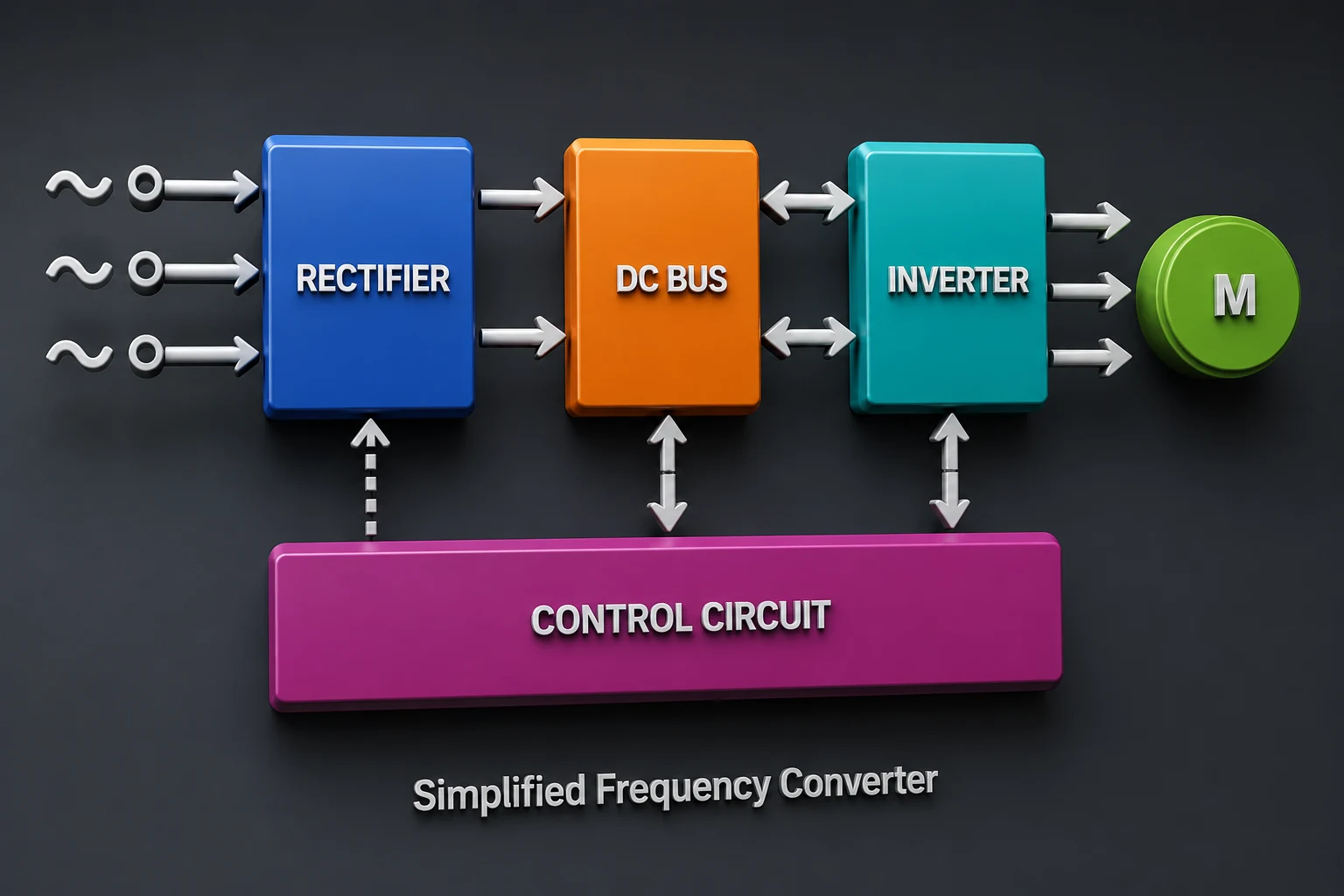
That three step journey, AC to DC to a new AC, is the entire VFD working principle in one sentence, and every VFD on the market, regardless of brand, follows this same basic path.
5 Facts About the VFD Working Principle
The Three Stage Journey, Visualized
This diagram is the visual core of the VFD working principle, showing exactly how power moves through the drive.
The Core VFD Formulas
Constant V/Hz Ratio: V / f = constant
Where:
Ns = synchronous speed (rpm)
f = supply frequency (Hz)
p = number of motor poles
V = applied voltage
Example: A 4-pole motor rated 460V at 60Hz Ns = (120 × 60) / 4 = 1800 rpm at full frequency V/Hz ratio = 460 / 60 = 7.67 At 30Hz, applied voltage should drop to roughly 30 × 7.67 ≈ 230V to keep this ratio constant Keeping V/Hz constant is what keeps the motor's magnetic flux, and therefore its available torque, roughly the same across its entire speed range. Push frequency up without raising voltage to match, and the motor becomes under fluxed and torque limited at that new speed.
Watch: Variable Frequency Drives Explained
This video walks through the rectifier, DC bus, and inverter stages with clear animations.
Why VFDs Save So Much Energy: The Cube Law
For centrifugal pumps and fans, a variable torque load, power required follows the cube of speed, not a straight line. Slowing a fan by 20% does not save 20% energy, it saves far more.
VFD Components at a Glance
This table maps every stage of the VFD working principle to its actual hardware.
| Stage | Key Components | Function |
|---|---|---|
| Rectifier | Diode bridge (or SCR bridge) | Converts incoming AC to pulsating DC |
| DC Bus | Filter capacitors, sometimes an inductor | Smooths ripple into stable DC voltage |
| Inverter | IGBTs (or GTOs on older/larger drives) | Switches DC into a new, variable frequency AC output |
| Controller | Microprocessor, feedback inputs | Sets frequency and voltage targets, maintains V/Hz ratio |
Where VFDs Are Actually Used
The cube law makes VFDs especially effective for variable flow pumping applications.
Matching fan speed to actual demand cuts energy use dramatically versus damper throttling.
A constant torque load, savings scale roughly in direct proportion to speed reduction.
Variable speed compression matches output to demand more efficiently than load/unload cycling.
Smooth acceleration and deceleration improve ride comfort and reduce mechanical wear.
Precise, adjustable speed control supports consistent product quality.
Quick FAQs: VFD Working Principle
These are the questions engineers ask most often once the basic VFD working principle meets a real motor control application.
External References
- The Engineering Mindset: Variable Frequency Drives Explained
- RealPars: What Is a Variable Frequency Drive (VFD)?
- Wikipedia: Variable Frequency Drive
What we learn today
- The VFD working principle follows three stages: a rectifier converts AC to rough DC, a DC bus smooths it, and an inverter rebuilds a new AC waveform at the required frequency.
- Motor speed depends directly on frequency, following Ns = 120f/p, which is why generating a new frequency is the entire point of a VFD.
- Voltage and frequency move together to maintain a constant V/Hz ratio, keeping motor torque consistent across the speed range.
- Centrifugal pumps and fans follow the cube law, so even modest speed reductions produce dramatic energy savings compared to constant torque loads like conveyors.