12 Types of Temperature Sensors Explained: Working Principle and Applications

Share:
Temperature Sensors

12 Types of Temperature Sensors Explained: Working Principle and Applications

From furnace-grade thermocouples to non-contact pyrometers, here is how each of the 12 major temperature sensor technologies actually works, and where each one earns its place.

Temperature RTD Sensor Thermocouple 12 Min Read
Temperature By Sunayana Gadepatil 12 Min Read

Temperature sensors are essential in industrial automation, HVAC, automotive, medical, and consumer electronics. This guide explains the 12 most common temperature sensors, their working principles, advantages, disadvantages, and applications.

What is a Temperature Sensor?

Temperature is one of the most frequently measured process variables in industrial automation, manufacturing, laboratories, and everyday electronic devices. Whether controlling a chemical reactor, monitoring a furnace, protecting an electric motor covered in our AC induction motors guide, or measuring body temperature, selecting the right sensor is essential for accurate and reliable measurement. A temperature sensor is a device that detects the temperature of an object, liquid, gas, or surrounding environment and converts it into a measurable signal, whether that is electrical resistance, voltage, a 4 to 20 mA current signal, a digital value, mechanical movement, or infrared radiation.
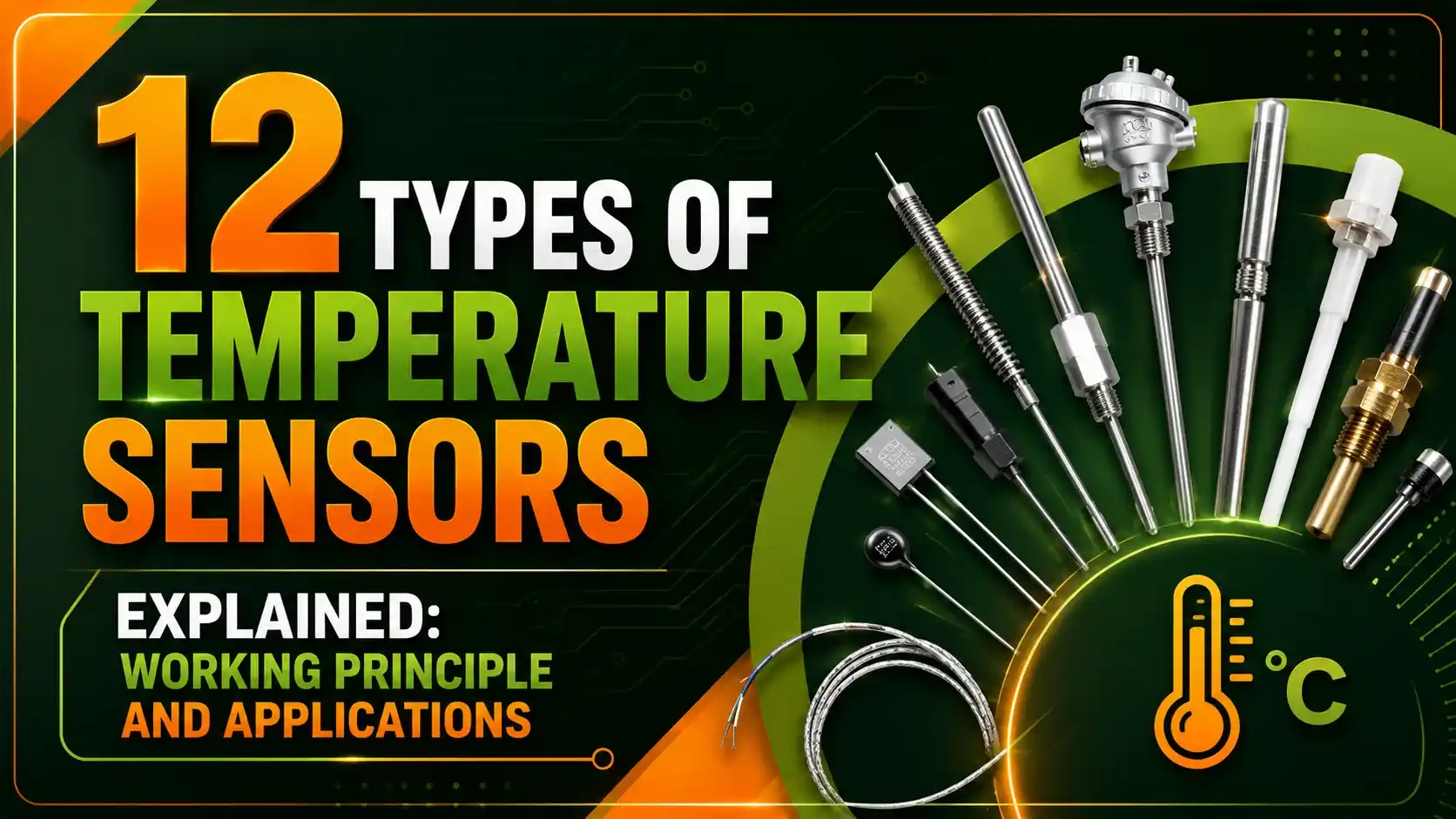
types of temperature sensors

Each sensor operates on a different physical principle. Some detect changes in electrical resistance, others generate a small voltage through basic Ohm's law relationships, while non-contact sensors measure infrared radiation emitted by an object. Because no single sensor suits every application, engineers must weigh temperature range, accuracy, response time, and installation method before choosing one, and confirm the final measurement with proper calibration practices. In this article, you will learn about the 12 most common temperature sensors, how they work, where they are used, and how to choose the best one for your application.

💡 Quick Summary: Temperature sensors convert temperature into an electrical or mechanical signal that can be measured, displayed, or used for process control. Different sensor technologies offer varying levels of accuracy, response time, operating range, and cost.
Advertisement
Advertisement

Contact vs Non-Contact Temperature Sensors

Temperature sensors fall into two broad categories depending on whether they touch the object being measured.

CategoryDescriptionExamples
Contact SensorsMust physically touch the object being measuredRTD, Thermocouple, Thermistor
Non-Contact SensorsMeasure temperature without touching the objectInfrared Thermometer, Thermal Camera, Optical Pyrometer
📖 Did You Know? The thermocouple is one of the most widely used industrial temperature sensors because it can measure temperatures exceeding 1,700°C, making it ideal for furnaces, kilns, and power plants.

12 Types of Temperature Sensors at a Glance

1
🔥

Thermocouple

2
🌡️

RTD (Pt100)

3

Thermistor

4
📡

Infrared Sensor

5
🔬

Semiconductor Sensor

6
📏

Bimetallic Sensor

7
💨

Gas Filled Sensor

8
💧

Liquid Filled Sensor

9
🧵

Fiber Optic Sensor

10
💻

Silicon Sensor

11
🔢

Digital Sensor

12
👁️

Optical Pyrometer

Advertisement
Advertisement

Detailed Guide to All 12 Types of Temperature Sensors

1

Thermocouple

A thermocouple is made by joining two different metal wires. When the junction is heated, it produces a small voltage through the Seebeck effect, proportional to the temperature difference.
Advantages: Extremely wide range, fast response, low cost, rugged.
Limitations: Lower accuracy than RTDs, needs cold junction compensation.
Applications: Boilers, furnaces, kilns, gas turbines, steel plants.
2

Resistance Temperature Detector (RTD)

An RTD measures temperature through changes in the electrical resistance of a metal, usually platinum. The most common type, the Pt100, reads 100 Ω at 0°C.
Advantages: High accuracy, excellent stability, good repeatability.
Limitations: Higher cost than thermocouples, slower response.
Applications: Pharmaceutical plants, food processing, laboratories, HVAC.
3

Thermistor

A thermistor is a temperature sensitive resistor whose resistance changes significantly with temperature, available as NTC or PTC types.
Advantages: Very high sensitivity, fast response, small size, low cost.
Limitations: Limited temperature range, non-linear response.
Applications: Medical thermometers, battery management, home appliances.
4

Infrared Temperature Sensor

An infrared sensor measures temperature without touching the object, detecting the infrared radiation naturally emitted by every surface.
Advantages: Non-contact, very fast response, safe for hazardous objects.
Limitations: Accuracy depends on emissivity, affected by dust and steam.
Applications: Moving conveyor belts, molten metals, electrical inspections.
5

Semiconductor Temperature Sensor

A semiconductor sensor is an IC that measures temperature using the temperature dependent electrical characteristics of a semiconductor junction.
Advantages: Small size, digital output available, good accuracy.
Limitations: Limited range, not suited to harsh industrial environments.
Applications: Computers, smartphones, IoT devices, embedded systems.
6

Bimetallic Temperature Sensor

Two different metal strips are bonded together. Since each metal expands at a different rate when heated, the strip bends, and that mechanical movement indicates temperature.
Advantages: Simple, rugged, no external power required.
Limitations: Lower accuracy, slower response, limited range.
Applications: Industrial dial thermometers, HVAC, ovens, refrigeration.
7

Gas Filled Temperature Sensor

A gas filled sensor uses the expansion of an inert gas inside a sealed bulb and capillary tube. As temperature rises, gas pressure increases proportionally.
Advantages: Long distance measurement, no electrical power required.
Limitations: Moderate accuracy, slower response, mechanical wear over time.
Applications: Power plants, oil refineries, marine engines, boilers.
8

Liquid Filled Temperature Sensor

A liquid filled sensor uses the thermal expansion of a liquid, such as mercury or alcohol, sealed inside a bulb and pressure element.
Advantages: Reliable, simple construction, no electrical supply required.
Limitations: Slower response, limited range, mechanical maintenance.
Applications: Industrial machinery, food processing, boilers, heat exchangers.
9

Fiber Optic Temperature Sensor

A fiber optic sensor measures temperature through changes in the wavelength, intensity, or phase of light traveling through an optical fiber, with no metallic conductor at the sensing point.
Advantages: Immune to EMI, excellent electrical isolation, very accurate.
Limitations: High cost, specialized equipment, complex installation.
Applications: MRI machines, high voltage transformers, nuclear plants, aerospace.
10

Silicon Temperature Sensor

A silicon sensor uses the temperature dependent forward voltage of a silicon diode, which changes predictably with temperature.
Advantages: Good accuracy, compact, low power, easy microcontroller interface.
Limitations: Limited range, unsuitable for extremely high temperatures.
Applications: Computer processors, battery chargers, power supplies.
11

Digital Temperature Sensor

A digital sensor combines a sensing element, signal conditioning, an ADC, and a digital communication interface such as I²C, SPI, or 1-Wire into a single IC.
Advantages: High accuracy, easy digital interface, good noise immunity.
Limitations: Limited industrial temperature range, needs a controller.
Applications: IoT devices, smart home systems, data loggers, weather stations.
12

Optical Pyrometer

An optical pyrometer is a non-contact instrument for extremely high temperatures. It compares the brightness of the target with a calibrated internal filament until the two visually match.
Advantages: Measures extremely high temperatures, no physical contact, long distance.
Limitations: Requires line of sight, accuracy depends on emissivity, higher cost.
Applications: Steel plants, glass manufacturing, cement kilns, foundries.
📌 Engineering Tip: There is no universal temperature sensor suitable for every application. The best choice depends on the required temperature range, accuracy, response time, environmental conditions, and installation method.
📖 Did You Know? Fiber optic sensors can measure temperature inside strong electromagnetic fields where conventional electrical sensors, and even standard galvanically isolated instruments, would fail.
Advertisement
Advertisement

Comparison of All 12 Types of Temperature Sensors

Sensor Type
Contact Type
Temp Range
Accuracy
Typical Applications
Thermocouple
Contact
Very High
Medium
Furnaces, boilers
RTD
Contact
Medium to High
Very High
Process industries
Thermistor
Contact
Low to Medium
High
Electronics
Infrared Sensor
Non-Contact
Medium to High
High
Moving objects
Semiconductor Sensor
Contact
Low to Medium
High
Consumer electronics
Bimetallic Sensor
Contact
Medium
Medium
HVAC
Gas Filled Sensor
Contact
High
Medium
Boilers
Liquid Filled Sensor
Contact
Medium
Medium
Industrial equipment
Fiber Optic Sensor
Contact
High
Very High
Medical, power systems
Silicon Sensor
Contact
Low to Medium
High
Embedded systems
Digital Sensor
Contact
Low to Medium
High
IoT devices
Optical Pyrometer
Non-Contact
Extremely High
High
Steel plants

How to Choose the Right Temperature Sensor

RequirementRecommended Sensor
Highest AccuracyRTD
Lowest CostThermocouple
Highest TemperatureOptical Pyrometer
Fastest ResponseThermocouple
Non-Contact MeasurementInfrared Sensor
Medical ApplicationsFiber Optic Sensor
Digital InterfaceDigital Temperature Sensor
Consumer ElectronicsThermistor
Advertisement
Advertisement

Common Temperature Sensor Selection Mistakes

✅ Do This

  • Match the sensor to the actual operating temperature range
  • Account for required response time before choosing
  • Select the correct thermowell material for the process
  • Consider vibration, moisture, and corrosive chemicals on site
  • Plan a calibration schedule from day one

❌ Avoid This

  • Choosing a sensor based only on price
  • Ignoring the operating temperature range
  • Selecting the wrong thermowell material
  • Using contact sensors where non-contact is actually required
  • Neglecting calibration requirements
💡 Engineering Tip: The most expensive temperature sensor is not always the best choice. Select based on the application's temperature range, accuracy, response time, installation method, and environmental conditions rather than price alone.

Types of Temperature Sensors: Video Walkthrough

Advertisement
Advertisement

Frequently Asked Questions About Types of Temperature Sensors

Which temperature sensor is the most accurate?
RTDs, especially platinum RTDs such as the Pt100 and Pt1000, are among the most accurate and stable temperature sensors used in industrial applications.
Which temperature sensor measures the highest temperature?
Optical pyrometers and certain thermocouples, such as Type B, R, and S, are suitable for measuring extremely high temperatures.
What is the difference between an RTD and a thermocouple?
An RTD measures temperature through changes in electrical resistance, while a thermocouple generates a small voltage using the Seebeck effect. RTDs generally offer higher accuracy, while thermocouples cover a wider temperature range.
Which temperature sensor is best for non-contact measurement?
Infrared temperature sensors and optical pyrometers are the most common choices for non-contact temperature measurement.
Where are thermistors commonly used?
Thermistors are widely used in consumer electronics, battery management systems, medical devices, HVAC systems, and household appliances due to their high sensitivity and low cost.
Do all temperature sensors need calibration?
Yes, all sensor types drift over time. Regular calibration against a traceable reference standard keeps readings accurate and defensible.
External References
Advertisement
Advertisement

What We Learn Today

  • Temperature sensors split into contact types (RTD, thermocouple, thermistor) and non-contact types (infrared, pyrometer)
  • Thermocouples win on range and cost, RTDs win on accuracy and stability
  • Thermistors are the most sensitive but only over a narrow temperature window
  • Fiber optic and gas or liquid filled sensors solve specific problems like EMI immunity or hazardous area installation
  • Digital and silicon sensors dominate IoT and embedded designs thanks to easy interfacing
  • The right sensor is chosen by matching range, accuracy, response time, and environment, not price alone
"I hope you like above blog. There is no cost associated in sharing the article in your social media. Thanks for Reading !! Happy Learning"

Leave a Reply

Your email address will not be published. Required fields are marked *