
How to Calculate Vacuum Pressure: Formula, Examples, and Unit Conversions
A gauge that reads negative is not lying to you, it is just speaking a different pressure language. Here is how to translate it correctly, every time.
Learn how to calculate vacuum pressure using simple formulas and practical examples. Understand the relationship between atmospheric pressure, absolute pressure, and gauge pressure in this beginner-friendly engineering guide.
What is Vacuum Pressure?
Vacuum-pressure is widely used in industries such as chemical processing, pharmaceuticals, food packaging, refrigeration, semiconductor manufacturing, laboratories, and power plants. Engineers frequently need to calculate it when designing vacuum systems, selecting pumps, troubleshooting equipment, or interpreting instrument readings.
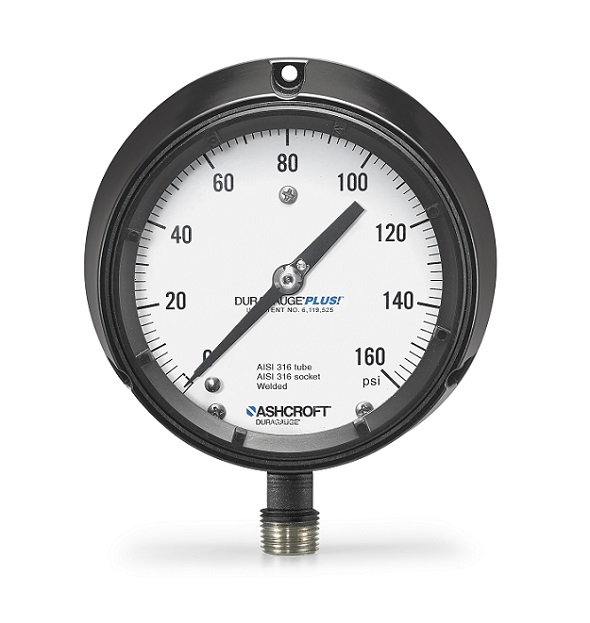
Unlike positive pressure, which pushes outward, this term represents pressure below atmospheric pressure. This concept confuses many beginners because vacuum gauges display values differently from standard pressure gauges. A gauge may indicate a negative pressure, but the actual pressure inside the vessel is never negative when measured on the absolute pressure scale. A vacuum is created whenever air or gas is removed from a container, and it is commonly measured using vacuum gauges, absolute pressure transmitters, vacuum transmitters, and compound pressure gauges.
Real Life Example
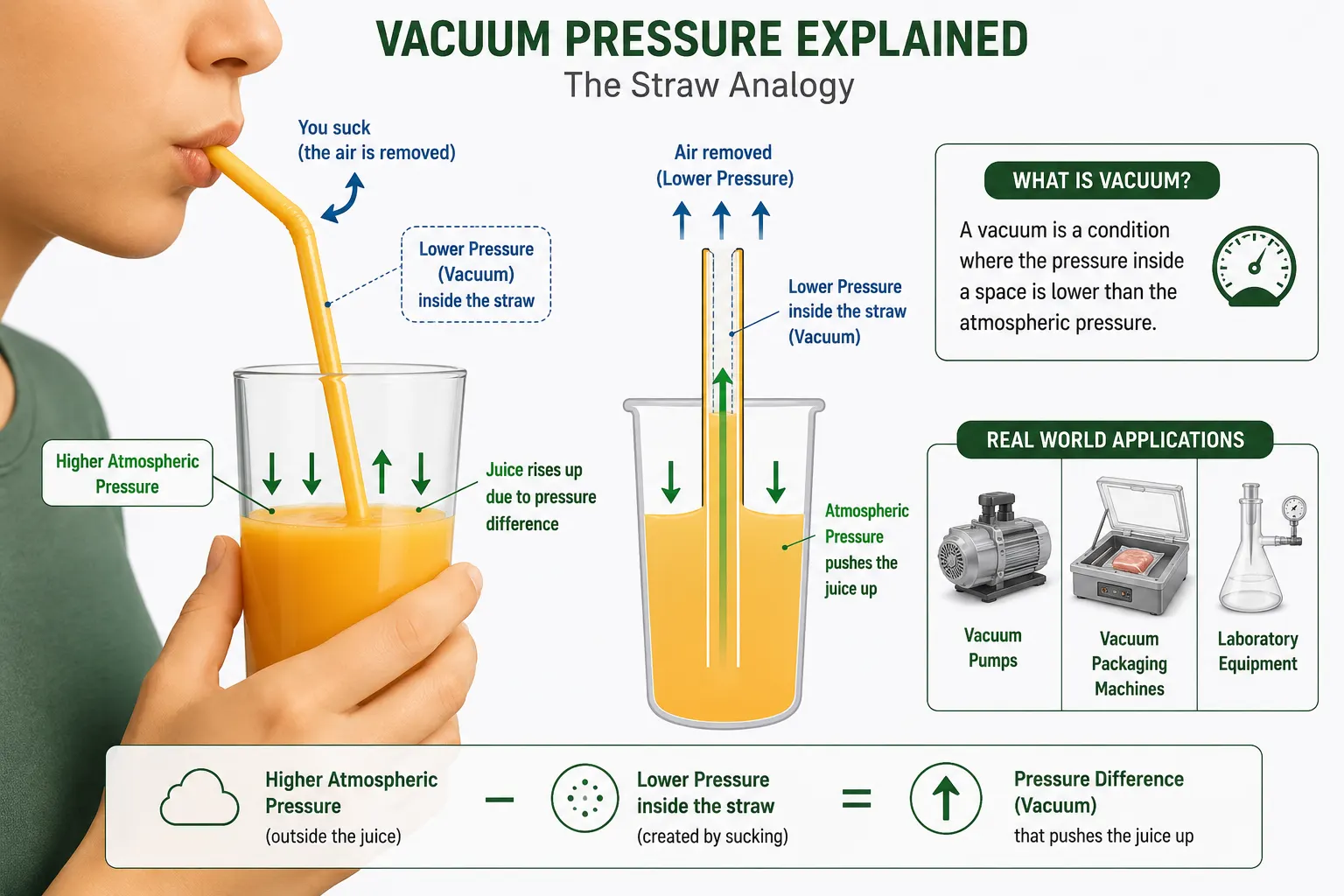
Imagine drinking juice through a straw. When you suck air out of the straw, the pressure inside becomes lower than atmospheric pressure. The higher atmospheric pressure acting on the juice surface then pushes the liquid upward into the straw. That pressure difference is a vacuum, and the same principle drives vacuum pumps, vacuum packaging machines, and laboratory equipment.
Why is Vacuum Pressure Important?
This kind of measurement is essential in many industrial processes because it helps engineers monitor and control systems operating below atmospheric pressure, including vacuum distillation, pharmaceutical drying, vacuum packaging, refrigeration systems, vacuum furnaces, laboratory experiments, semiconductor manufacturing, and chemical reactors. Accurate measurement improves process efficiency, product quality, and equipment safety.
Absolute pressure is always measured from a perfect vacuum and can never be negative. Gauge pressure is measured relative to atmospheric pressure, so it reads positive above atmospheric and negative below it. Vacuum describes how far below atmospheric the absolute pressure has dropped, and by convention it is always expressed as a positive number.
Types of Pressure Used in Vacuum Calculations
| Pressure Type | Reference Point | Can Be Negative? |
|---|---|---|
| Atmospheric Pressure | Earth's atmosphere at sea level, ≈101.325 kPa | No |
| Absolute Pressure | Perfect vacuum (0 Pa) | No |
| Gauge Pressure | Local atmospheric pressure | Yes, indicates vacuum |
Vacuum Pressure Formula
More Step-by-Step Vacuum Pressure Examples
| Example | Given | Formula | Result |
|---|---|---|---|
| Absolute pressure from vacuum | Atm = 101.3 kPa, Vacuum = 80 kPa | Absolute = Atm − Vacuum | 21.3 kPa |
| Vacuum pressure in bar | Atm = 1.013 bar, Absolute = 0.40 bar | Vacuum = Atm − Absolute | 0.613 bar |
| Vacuum pressure in psi | Atm = 14.7 psi, Absolute = 6 psi | Vacuum = Atm − Absolute | 8.7 psi |
| Gauge pressure under vacuum | Absolute = 60 kPa, Atm = 101.3 kPa | Gauge = Absolute − Atm | −41.3 kPa |
Vacuum Pressure Calculator
Vacuum, Absolute, and Gauge Pressure Calculator
Pick what you want to solve forCommon Vacuum-Pressure Units
| Unit | Symbol | Typical Applications |
|---|---|---|
| Pascal | Pa | Scientific research |
| Kilopascal | kPa | Industrial automation |
| Bar | bar | Process industries |
| Millibar | mbar | Vacuum systems |
| Pounds per Square Inch | psi | Mechanical engineering |
| Millimeters of Mercury | mmHg | Medical and laboratory equipment |
| Torr | Torr | High-vacuum applications |
| Inches of Mercury | inHg | Refrigeration and HVAC |
Vacuum-Pressure Unit Conversion (1 atm equals)
| Unit | Equivalent to 1 atm |
|---|---|
| Kilopascal | 101.325 kPa |
| Bar | 1.01325 bar |
| Psi | 14.696 psi |
| mmHg | 760 mmHg |
| Torr | 760 Torr |
Applications of Vacuum Pressure Calculation
Vacuum Packaging
Removes air from food products to extend shelf life and reduce spoilage.
Chemical Processing
Vacuum reactors allow reactions at lower temperatures with improved product quality.
Pharmaceutical Industry
Vacuum drying removes moisture from medicines without excessive heat.
Power Plants
Steam condensers operate under vacuum to improve turbine efficiency.
Refrigeration Systems
Vacuum pumps remove moisture and air before charging refrigerant.
Semiconductor Manufacturing
Integrated circuits are built inside clean vacuum chambers to prevent contamination.
Absolute Pressure vs Vacuum Pressure
| Feature | Absolute Pressure | Vacuum Pressure |
|---|---|---|
| Reference | Perfect vacuum | Atmospheric pressure |
| Can Be Zero | Yes | No |
| Can Be Negative | No | No |
| Used In | Pressure transmitters | Vacuum gauges |
| Typical Unit | kPa(a), bar(a) | kPa Vacuum, mmHg Vacuum |
Common Vacuum Pressure Calculation Mistakes
- Confusing gauge pressure with absolute pressure
- Assuming atmospheric pressure is always exactly 101.325 kPa, when it varies with altitude and weather
- Ignoring pressure unit conversions
- Mixing bar(g) and bar(a)
- Forgetting to specify whether the pressure is gauge, absolute, or vacuum pressure
- Assuming vacuum pressure can be greater than atmospheric pressure
Engineer's Vacuum Pressure Checklist
- Pressure units are consistent
- Atmospheric pressure is known
- Instrument measures absolute or gauge pressure
- Correct formula is selected
- Pressure reference is clearly identified
- Unit conversion is completed if required
Vacuum Pressure Calculation: Video Walkthrough
Frequently Asked Questions About Vacuum Pressure
- Ashcroft, Vacuum Pressure vs Absolute and Gauge Pressure
- Renke, Gauge Pressure, Absolute Pressure and Vacuum Pressure
- Engineering Archives, Absolute, Gage, Vacuum, and Atmospheric Pressures
What We Learn Today
- Vacuum pressure is the difference between atmospheric pressure and the absolute pressure inside a system
- The basic formula is Vacuum Pressure = Atmospheric Pressure − Absolute Pressure
- Absolute pressure is always positive, gauge pressure can read negative to indicate vacuum
- These calculations are widely used in refrigeration, chemical processing, pharmaceuticals, laboratories, and semiconductor manufacturing
- Knowing whether an instrument reads absolute or gauge pressure prevents the most common calculation errors
- Unit conversions between kPa, bar, psi, mmHg, and Torr are routine parts of vacuum system design