
Linear vs Switching Voltage Regulators: Efficiency, Noise, and When to Use Each
One burns the extra voltage off as heat. The other chops it up and stores it in an inductor. Same job, completely different tradeoffs, and picking wrong means either a scorching heat sink or a noisy sensor circuit.
Linear and switching voltage regulators both drop a higher DC voltage down to a stable lower one, but they achieve it in fundamentally different ways. This guide compares their efficiency, noise, and cost, with a live power dissipation calculator to show exactly how much heat a linear regulator has to shed.
What is a Voltage Regulator?
A voltage regulator is a circuit that takes an unregulated or higher input voltage and delivers a stable, lower output voltage regardless of variations in input voltage or load current. Nearly every piece of electronics, from a simple 5V logic board to a PLC power supply, depends on one somewhere in its power chain.
There are two fundamentally different families of voltage regulator: linear regulators, which include the classic 7805 and Zener-based designs, and switching regulators, such as buck converters. Both accomplish the same goal, but the physics behind how they do it produces very different tradeoffs in efficiency, heat, noise, and cost.
Real Life Example
Think of a linear regulator like a bathtub faucet with only a hot water line. To get lukewarm water, you leave the hot water running full blast and simply let some of it drain away unused down a second pipe, wasting energy to reach the temperature you want. A switching regulator is more like a smart mixing valve that pulses the hot water on and off extremely fast, using almost all of the energy it takes in, converting it rather than throwing the excess away.
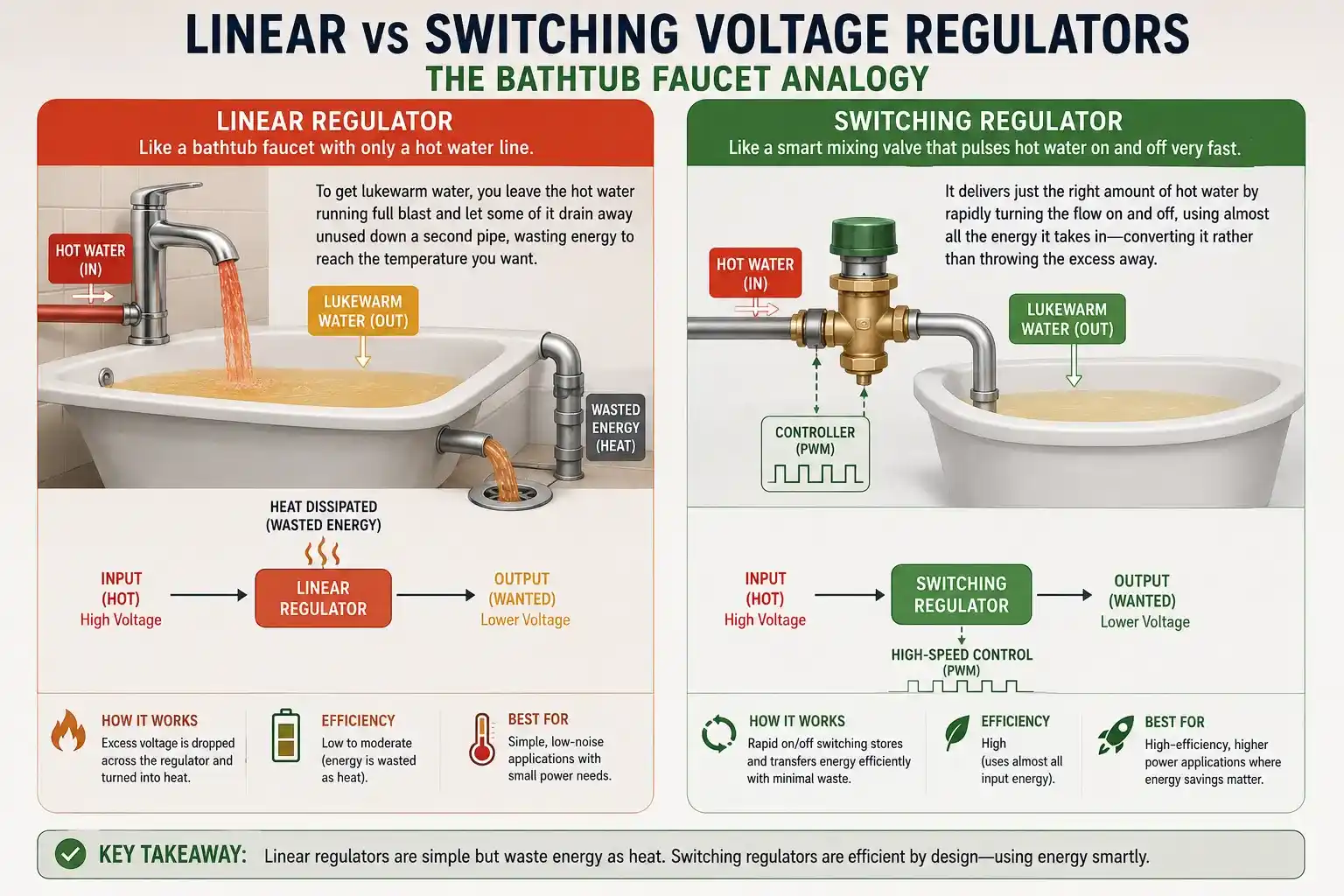
Linear vs Switching Regulators
🔌 Linear Regulator
⚡ Switching Regulator (Buck Converter)
Linear Regulator Formulas
Linear Regulator Power Dissipation Calculator
Linear Regulator Heat and Efficiency Calculator
See exactly how much power a linear regulator has to dissipateComparison Table
Applications
Audio Circuits
Linear regulators keep power rails clean where switching noise would leak into sensitive audio signals.
RF and Sensor Front Ends
Low noise linear regulation protects precision analog and RF measurement circuits.
Battery-Powered Devices
Switching regulators extend battery life dramatically by wasting far less energy as heat.
Computer Power Supplies
Multiple switching stages efficiently step 12V rails down to core CPU voltages under high current.
Industrial Control Panels
Switching supplies convert mains-derived DC down to 24V and 5V rails with minimal heat buildup.
Small Sensor Boards
Simple linear regulators remain popular for low current, low drop applications on small PCBs.
Linear vs Switching Regulator: Video Walkthrough
Frequently Asked Questions
- All About Circuits, Buck Regulator vs Linear Voltage Regulator
- Electronics and Embedded Systems, LM2596 Buck Converter vs LM7805 Linear Regulator
- Electronics For U, Buck Converter vs Linear Voltage Regulator
What We Learn Today
- Linear regulators drop excess voltage as heat, capping efficiency at Vout/Vin, but produce very clean output
- Switching regulators convert rather than dissipate excess energy, reaching 80 to 95% efficiency at the cost of some noise
- Power dissipated by a linear regulator follows P = (Vin - Vout) x I, directly showing why large voltage drops mean serious heat
- LDO regulators can rival switching efficiency specifically when the input-output voltage differential is small
- Choose linear for simplicity and low noise at low current, switching for efficiency at higher current or larger voltage drops