
TN, TT, and IT Earthing Systems Explained: IEC 60364 Types Compared
Two letters decide what happens to a piece of equipment the instant a live wire touches its metal casing: whether a breaker trips in milliseconds, or the whole enclosure quietly becomes dangerous to touch.
TN, TT, and IT are the three earthing system families defined by IEC 60364, each arranging the connection between the power source, the equipment earth, and the earth itself differently. This guide explains the letter code, compares TN-S, TN-C, TN-C-S, TT, and IT, and shows where each is typically used.
TN TT IT Earthing Systems
IEC 60364 identifies each earthing system using a code of two or more letters. The first letter describes how the power source itself relates to earth: T means one point, usually the neutral, is directly connected to earth, while I means the source is isolated from earth or connected through very high impedance. The second letter describes how the exposed conductive parts of the installation, equipment enclosures and the like, are earthed: T means they have their own independent earth connection, while N means they connect back to the source's earthed point.
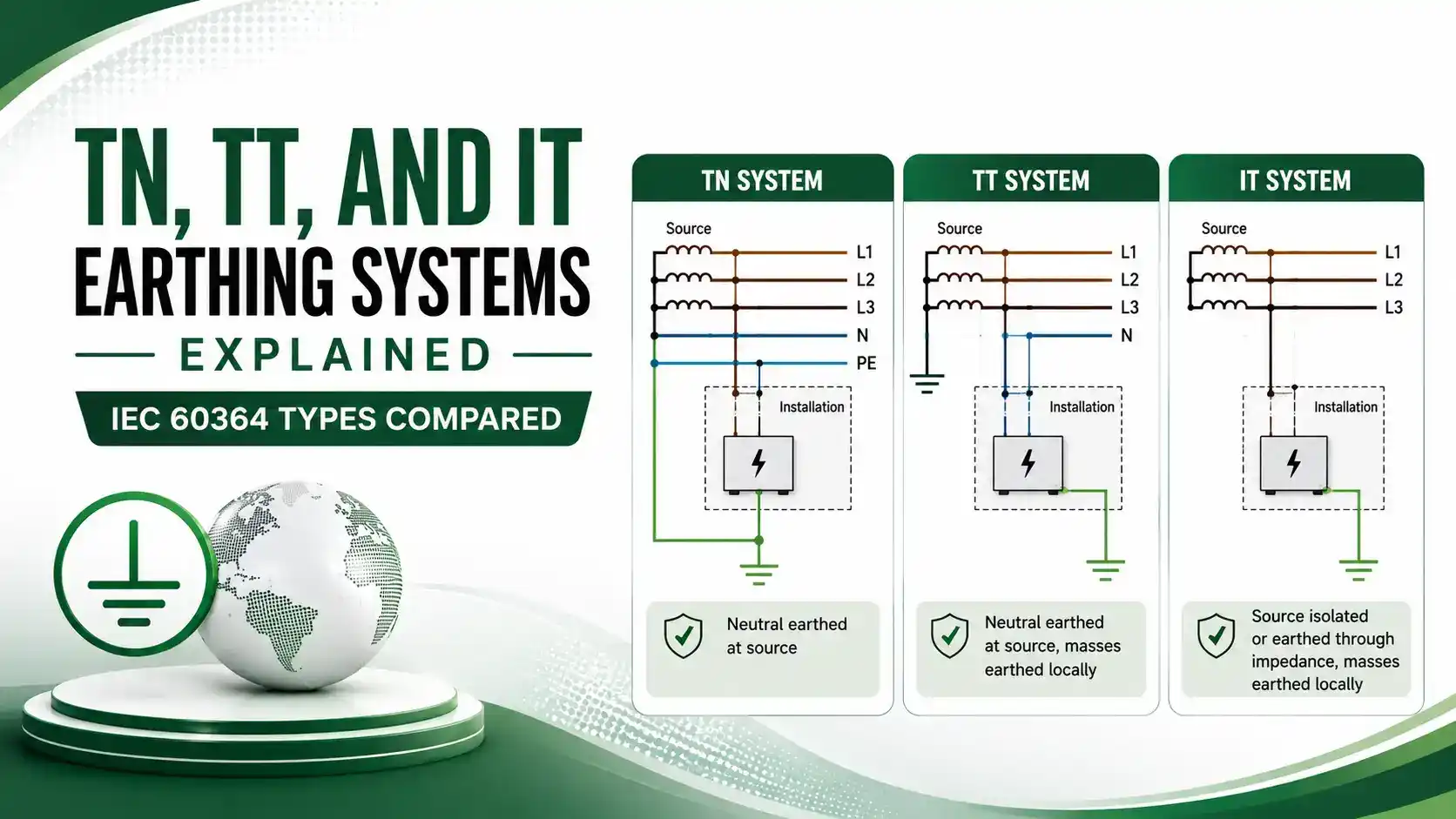
Additional letters describe how neutral and protective earth functions are arranged within a TN system: S means the neutral (N) and protective earth (PE) conductors are kept fully separate, while C means they are combined into a single PEN conductor. This system underlies how earthing resistance requirements and protective device coordination are actually specified for a given installation.
Real Life Example
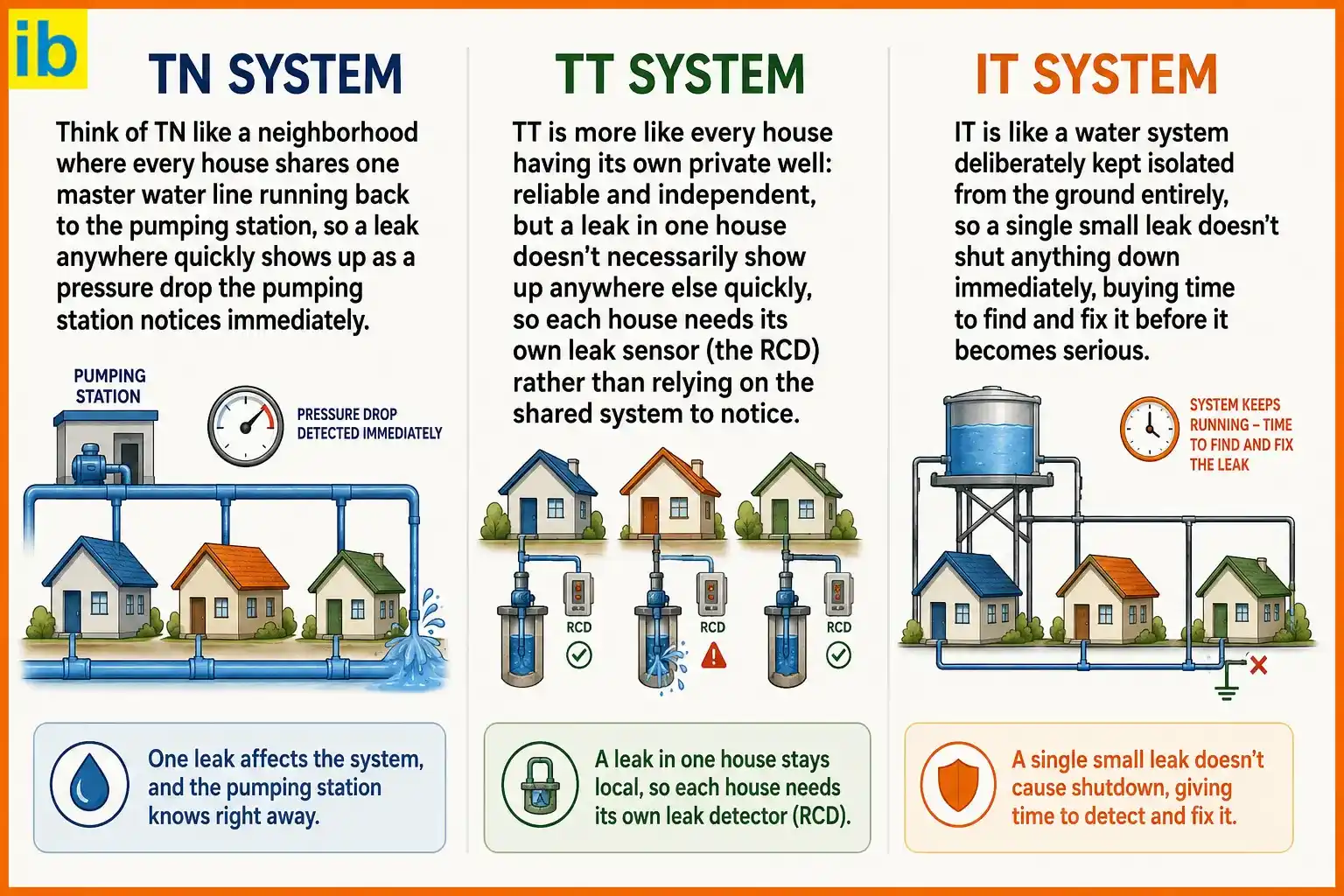
Think of TN like a neighborhood where every house shares one master water line running back to the pumping station, so a leak anywhere quickly shows up as a pressure drop the pumping station notices immediately.
TT is more like every house having its own private well: reliable and independent, but a leak in one house doesn't necessarily show up anywhere else quickly, so each house needs its own leak sensor (the RCD) rather than relying on the shared system to notice.
IT is like a water system deliberately kept isolated from the ground entirely, so a single small leak doesn't shut anything down immediately, buying time to find and fix it before it becomes serious.
IEC Letter Code
1st Letter: Terre (Earth)
One point of the power source, usually neutral, is directly connected to earth.
1st Letter: Isolé (Isolated)
The power source is isolated from earth, or earthed via very high impedance.
2nd Letter: Terre (Earth)
Exposed equipment parts have an independent earth connection, separate from the source.
2nd Letter: Neutre (Neutral)
Exposed equipment parts connect back to the source's own earthed neutral point.
The Three Earthing System Families
🔌 TN System (TN-S, TN-C, TN-C-S)
Source neutral is earthed, and equipment earths connect back to that same point. TN-S keeps neutral and earth fully separate. TN-C combines them into one PEN conductor. TN-C-S combines them upstream, then separates them at the installation. Low earth loop impedance allows standard breakers to clear faults quickly.
🌍 TT System
Source neutral is earthed, but the installation uses its own completely independent earth electrode, unconnected to the source's earth. Earth loop impedance is typically too high for standard breakers alone, so RCDs are essential for protection.
🏝️ IT System
Source is isolated from earth or earthed through very high impedance. A first insulation fault does not trip the supply, preserving continuity, but requires an insulation monitoring device to detect and alert on faults before a second fault creates a genuine hazard.
Comparison Table
IT systems sit apart from this table entirely: rather than optimizing fault clearance speed, they prioritize continuity of supply, common in hospital operating theaters, mines, and process plants where an unplanned trip on the first fault would itself be dangerous.
Applications
Commercial Buildings
TN-C-S is the most common arrangement in many general low voltage installations.
Rural and Overhead Supply
TT systems are common where overhead distribution makes a shared earth conductor impractical.
Telecom and Data Centers
TT's independent earthing reduces interference from other connected equipment.
Hospital Operating Theaters
IT systems keep critical equipment running through a single first fault.
Mining and Process Plants
IT systems prevent unplanned shutdowns from a single insulation fault in continuous processes.
Marine and Offshore
IT and TT systems both see use aboard vessels for continuity and interference control.
TN, TT, and IT Earthing Systems: Video Walkthrough
Frequently Asked Questions
- Wikipedia, Earthing System
- Electrical Safety Engineering and Standards, Types of Earthing Systems: TN, TT, and IT Explained
- ELEK Software, Earthing System Types Explained
What We Learn Today
- IEC 60364 defines earthing systems using a letter code: first letter for the source, second for equipment earthing
- TN systems connect equipment earths back to the source's own earthed neutral, enabling fast fault clearance
- TT systems use an independent local earth electrode, relying on RCDs due to higher loop impedance
- IT systems isolate the source from earth, prioritizing continuity of supply through a single fault
- Each system trades fault-clearance speed, interference immunity, and continuity of supply differently