
What Is a Process Historian? Data Collection, Compression, and Applications
Every sensor in your plant produces a value every second. A process historian is the reason you can still ask what happened at 3:47 AM last Tuesday, years later, without drowning in raw data.
A process historian collects, compresses, and stores time-stamped data from PLCs, DCS, and SCADA systems for months or years of retrieval. This guide explains how tags, compression, and quality codes work, and how a historian differs from the SCADA system it sits beside.
What is a Process Historian?
A process historian, also called a data historian or operational historian, is specialized software designed to collect, compress, store, and retrieve time-stamped process data from industrial equipment such as sensors, PLCs, distributed control systems, and SCADA systems. Unlike a general-purpose relational database built for transactional records, a historian is purpose-built for one job: storing the continuous state of every monitored process variable, timestamped precisely, for months or years of operational history.
Historians were first developed in the 1980s, with OSIsoft (now part of AVEVA) generally credited with the earliest widely deployed system, the PI System. Today historians sit in nearly every process plant across oil and gas, chemicals, pharmaceuticals, and power generation, quietly capturing what a SCADA screen only shows for a moment before it updates again.
Real Life Example
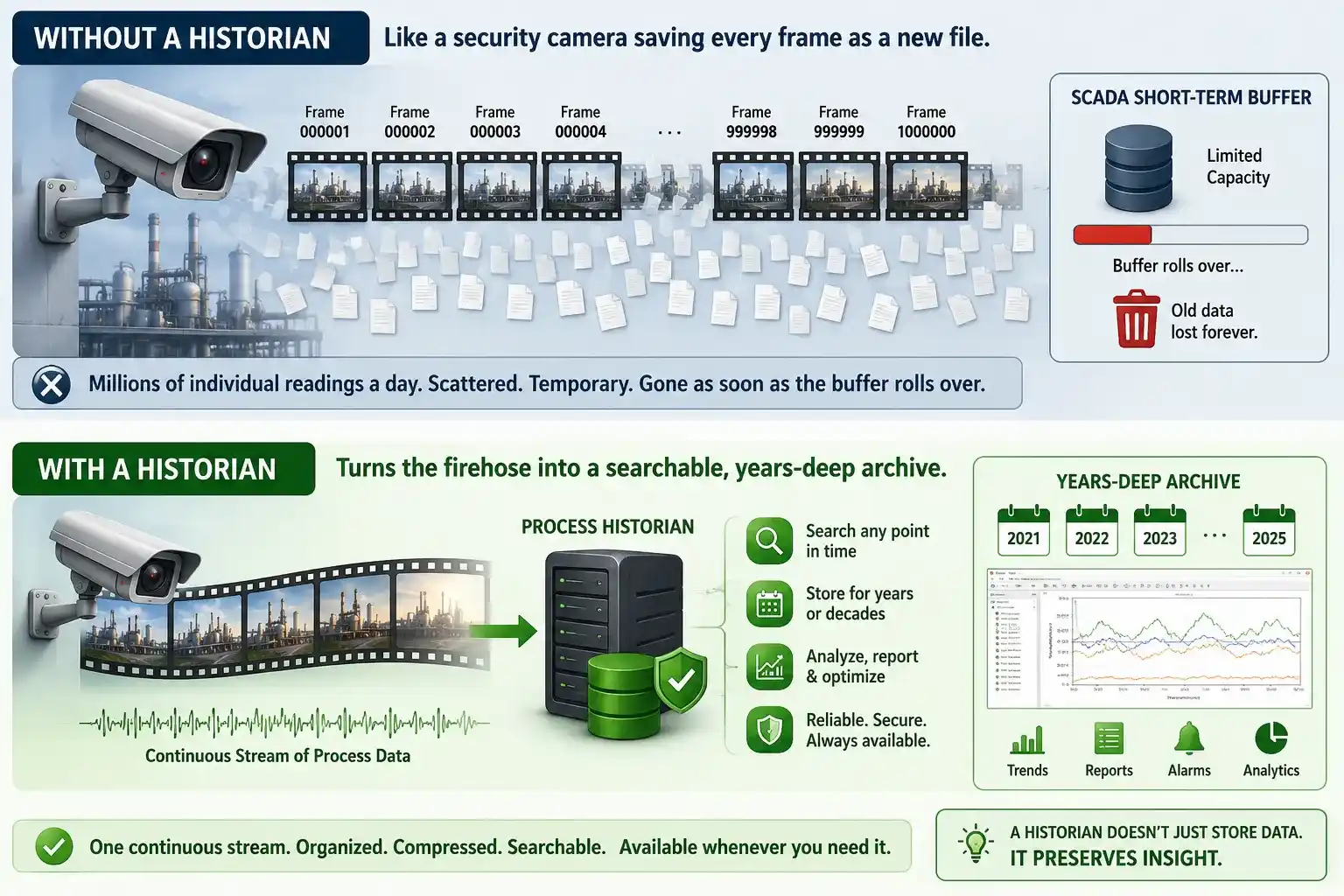
Imagine a security camera that recorded a brand new video file every single frame, forever, instead of one continuous stream you can scrub back through. That is what industrial process data would look like without a historian: millions of individual readings a day, scattered across whatever short-term buffer the SCADA system happens to hold, gone the moment that buffer rolls over. A historian is what turns that firehose into a searchable, years-deep archive.
How a Historian Collects and Stores Data
Data Collection
Interfaces connect to PLCs, DCS, and SCADA via OPC UA, OPC DA, or Modbus, reading tag values many times per second.
Tagging and Timestamping
Each value is stored against a unique tag name with a precise timestamp and a quality code.
Compression
Exception reporting and swinging door algorithms discard redundant points while preserving the underlying trend.
Retrieval and Analysis
Client tools query the archive by tag and time range for trending, reporting, or predictive maintenance.
How Historian Compression Works
Two compression techniques do most of the work in a typical historian. Exception reporting stores a new value only when the reading changes beyond a configured deadband, so a temperature sensor holding steady at 72.3 degrees for thirty seconds contributes just one stored point instead of thirty. Swinging door compression goes a step further, fitting a linear trend segment through consecutive readings and storing only the segment's endpoints as long as every point in between falls within a tolerance corridor.
Together, these two techniques are what let a historian retain years of high-resolution data in a fraction of the space a naive, uncompressed database would require, without meaningfully harming the ability to reconstruct what actually happened during a process upset.
Historian Storage Savings Calculator
Historian Compression Savings Estimator
Illustrative estimate based on a typical compression ratioHistorian vs SCADA vs Relational Database
Applications of Process Historians
Oil and Gas
Wellhead telemetry, pipeline pressure transients, and compressor station performance tracking.
Pharmaceutical
Electronic batch records and FDA 21 CFR Part 11 compliant audit trails built on historian event frames.
Power Generation
Turbine vibration, boiler drum level, and generator excitation data at millisecond resolution.
Manufacturing
OEE tracking, quality monitoring, and root cause analysis of production downtime events.
Predictive Maintenance
Long-term trend data feeds condition-based maintenance and failure prediction models.
Chemical Processing
Reactor and distillation column historical data supports process optimization studies.
Process Historian: Video Walkthrough
Frequently Asked Questions About Process Historians
- Wikipedia, Operational Historian
- Tiger Data, What Is a Data Historian?
- Software Toolbox, What Is a Data Historian?
What We Learn Today
- A process historian collects, compresses, and archives time-stamped industrial data for months or years of retrieval
- Data is stored using a tag-based model: tag name, timestamp, value, and quality code
- Exception reporting and swinging door compression together can achieve 1000:1 or better compression ratios
- A historian complements SCADA rather than replacing it, trading real-time control for long-term archiving
- Compression settings must be tuned per tag to avoid smoothing away genuinely important short-lived events