
How to Calculate Gauge Pressure: Formula, Examples, and Unit Conversions
Understand the relationship between gauge pressure, atmospheric pressure, and absolute pressure with simple formulas and practical engineering examples.
Learn how to calculate gauge pressure using simple formulas and practical engineering examples. Understand the relationship between gauge pressure, atmospheric pressure, and absolute pressure in this beginner-friendly guide.
What is Gauge Pressure?
Pressure gauges are among the most commonly used instruments in industrial plants, hydraulic systems, air compressors, boilers, refrigeration units, and water distribution networks. However, many students and beginner engineers become confused when interpreting pressure gauge readings because the value displayed on a gauge is not the actual pressure inside the system. Instead, it represents the pressure relative to atmospheric pressure.
For example, if an air compressor pressure gauge reads 5 bar, it does not mean the absolute pressure inside the tank is 5 bar. Since atmospheric pressure already exists around us, the actual pressure inside the tank is higher than the gauge reading. Understanding how to calculate gauge pressure is essential for pressure transmitter calibration, process calculations, equipment design, and troubleshooting industrial systems.
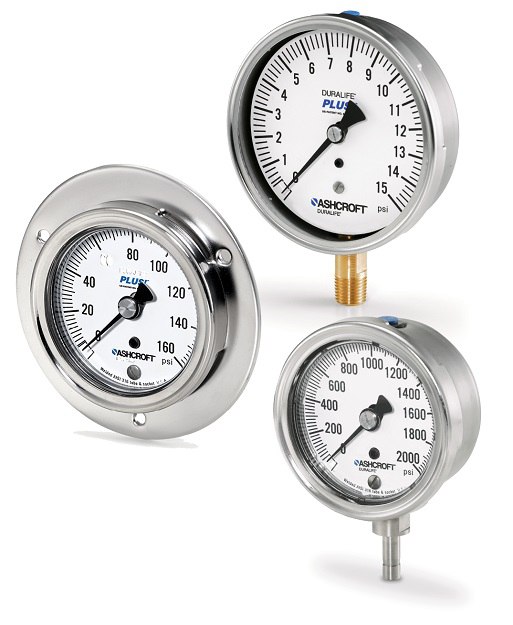
Gauge pressure is the pressure measured relative to atmospheric pressure. A standard pressure gauge automatically uses atmospheric pressure as its zero reference. Therefore, a gauge reading of 0 kPa means the pressure inside the system is equal to atmospheric pressure. Positive readings indicate pressure above atmospheric pressure, and negative readings indicate pressure below atmospheric pressure, which is vacuum. Gauge pressure is represented as kPa(g), bar(g), or psi(g), where (g) stands for gauge.
Real Life Example
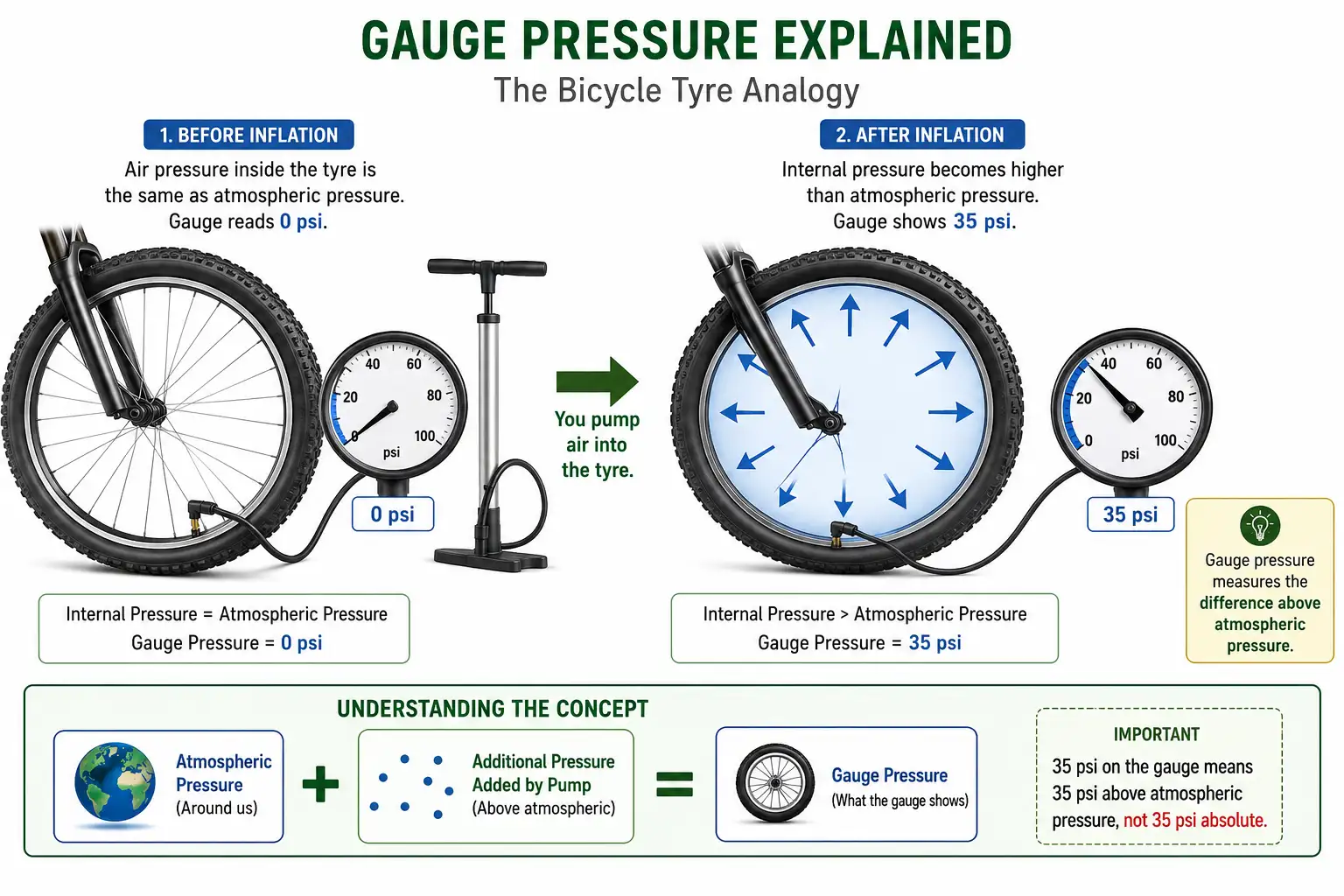
Imagine inflating a bicycle tyre. Before inflation, the air pressure inside the tyre is the same as the surrounding atmosphere, so the pressure gauge reads 0 psi. As you pump air into the tyre, the internal pressure becomes higher than atmospheric pressure. If the gauge shows 35 psi, it means the tyre pressure is 35 psi above atmospheric pressure, not 35 psi absolute.
Why is Gauge Pressure Important?
Gauge pressure is widely used because it indicates the effective pressure acting on equipment. It is commonly used in air compressors, hydraulic systems, water pipelines, steam boilers, pressure vessels, pneumatic systems, industrial process plants, and refrigeration systems. Most industrial pressure gauges display gauge pressure, making it the most familiar pressure measurement for technicians and maintenance engineers.
Types of Pressure Used in Gauge Pressure Calculations
Before calculating gauge pressure, it is important to understand the three pressure references used in engineering.
| Pressure Type | Description | Typical Units |
|---|---|---|
| Atmospheric Pressure | The pressure exerted by the Earth's atmosphere. At sea level, approximately 101.325 kPa, 1.01325 bar, or 14.7 psi. | kPa, bar, psi |
| Absolute Pressure | Measured from a perfect vacuum. It always includes atmospheric pressure. | kPa(a), bar(a), psi(a) |
| Gauge Pressure | Measured relative to atmospheric pressure. Can be positive, zero, or negative (vacuum). | kPa(g), bar(g), psi(g) |
Relationship Between Absolute Pressure and Gauge Pressure
The relationship between the two is very simple. If the pressure inside a system is higher than atmospheric pressure, the result is positive. If it is lower than atmospheric pressure, the result becomes negative, indicating vacuum.
Gauge Pressure Formula
More Step-by-Step Gauge Pressure Examples
| Example | Given | Formula | Result |
|---|---|---|---|
| Absolute pressure from gauge | Gauge = 300 kPa, Atm = 101.3 kPa | Absolute = Gauge + Atm | 401.3 kPa(a) |
| Gauge pressure in bar | Absolute = 5 bar, Atm = 1.013 bar | Gauge = Absolute − Atm | 3.99 bar(g) |
| Gauge pressure in psi | Absolute = 100 psi, Atm = 14.7 psi | Gauge = Absolute − Atm | 85.3 psi(g) |
| Negative gauge pressure (vacuum) | Absolute = 40 kPa, Atm = 101.3 kPa | Gauge = Absolute − Atm | −61.3 kPa |
Gauge Pressure Calculator
Gauge and Absolute Pressure Calculator
Pick what you want to solve forCommon Pressure Units
Gauge pressure can be expressed using several engineering units.
| Unit | Symbol | Common Applications |
|---|---|---|
| Pascal | Pa | Scientific research |
| Kilopascal | kPa | Industrial automation |
| Bar | bar | Process industries |
| Pounds per Square Inch | psi | Mechanical engineering |
| Megapascal | MPa | High-pressure systems |
| Kilogram per Square Centimeter | kg/cm² | Older industrial equipment |
Pressure Unit Conversion
| Unit | Equivalent |
|---|---|
| 1 atm | 101.325 kPa |
| 1 atm | 1.01325 bar |
| 1 atm | 14.696 psi |
| 1 bar | 100 kPa |
| 1 MPa | 1000 kPa |
| 1 psi | 6.895 kPa |
These conversions are frequently used when calibrating pressure transmitters and interpreting equipment specifications.
Gauge Pressure vs Absolute Pressure
Although closely related, gauge pressure and absolute pressure use different reference points.
| Feature | Gauge Pressure | Absolute Pressure |
|---|---|---|
| Reference | Atmospheric Pressure | Perfect Vacuum |
| Zero Point | Atmospheric Pressure | Absolute Zero Pressure |
| Can Be Negative | Yes (Vacuum) | No |
| Common Instruments | Pressure Gauges | Absolute Pressure Sensors |
| Typical Units | bar(g), psi(g), kPa(g) | bar(a), psi(a), kPa(a) |
Industrial Applications of Gauge Pressure
Gauge pressure is used extensively because most industrial processes operate above atmospheric pressure.
Air Compressors
Pressure gauges monitor compressed air systems to ensure safe and efficient operation.
Hydraulic Systems
Hydraulic machines rely on gauge pressure to generate force for lifting, pressing, and moving heavy loads.
Steam Boilers
Boiler operators monitor gauge pressure to maintain safe steam generation and prevent overpressure conditions.
Water Distribution Systems
Municipal water supply networks use gauge pressure to ensure adequate water flow throughout pipelines.
Pneumatic Systems
Factories use gauge pressure to control pneumatic cylinders, actuators, and automation equipment.
Refrigeration and Air Conditioning
Technicians measure both positive and negative gauge pressure during system charging, evacuation, and troubleshooting.
Common Mistakes
Avoid these common errors when calculating gauge pressure.
- Confusing gauge pressure with absolute pressure
- Assuming atmospheric pressure is always exactly 101.325 kPa, when it varies with altitude and weather conditions
- Forgetting to identify whether the pressure value is expressed as (g) or (a)
- Mixing pressure units such as bar, psi, and kPa without proper conversion
- Ignoring negative gauge pressure in vacuum applications
- Using gauge pressure instead of absolute pressure in gas law calculations
Engineer's Checklist
Before calculating gauge pressure, verify the following.
- Pressure units are consistent
- Atmospheric pressure is known or assumed correctly
- Instrument measures gauge or absolute pressure
- Correct formula is selected
- Pressure reference is clearly identified
- Unit conversion has been completed if required
Gauge Pressure Calculation: Video Walkthrough
Frequently Asked Questions About Gauge Pressure
- Lumen Learning, Gauge Pressure, Absolute Pressure, and Pressure Measurement
- Engineering Archives, Absolute, Gage, Vacuum, and Atmospheric Pressures
- Calculator Academy, Gauge Pressure Calculator
What We Learn Today
- Gauge pressure is the pressure measured relative to atmospheric pressure, indicating how much the system pressure is above or below the surrounding atmosphere
- The basic formula is Gauge Pressure = Absolute Pressure − Atmospheric Pressure; add atmospheric pressure to gauge pressure to find absolute pressure
- Gauge pressure is widely used in air compressors, hydraulic systems, boilers, water distribution networks, pneumatic equipment, refrigeration systems, and industrial pressure vessels
- Understanding the relationship between gauge pressure, absolute pressure, and atmospheric pressure helps engineers perform accurate calculations, calibrate instruments correctly, and avoid common pressure measurement errors