
Star vs Delta Connection Explained: Line and Phase Voltage Relationships
Wire three coils into a triangle, or wire them all back to one shared point. That single decision decides whether you get a neutral wire and dual voltages, or a robust, neutral-free supply built for raw power.
Star and delta are the two ways of wiring a three-phase system's windings, and the choice fundamentally changes the relationship between line voltage, phase voltage, and current. This guide explains both configurations, the √3 relationship, and where each is used in practice.
What is Star and Delta Connection?
A three-phase electrical system uses three separate windings, and how those three windings are wired together defines whether the system is star or delta connected. In a star (or Wye) connection, one end of each of the three windings is joined together at a common central point, called the star point or neutral point, forming a four-wire system when that neutral is brought out. In a delta connection, the windings are joined end-to-end in a closed triangular loop, with no common point and no neutral, forming a three-wire system.
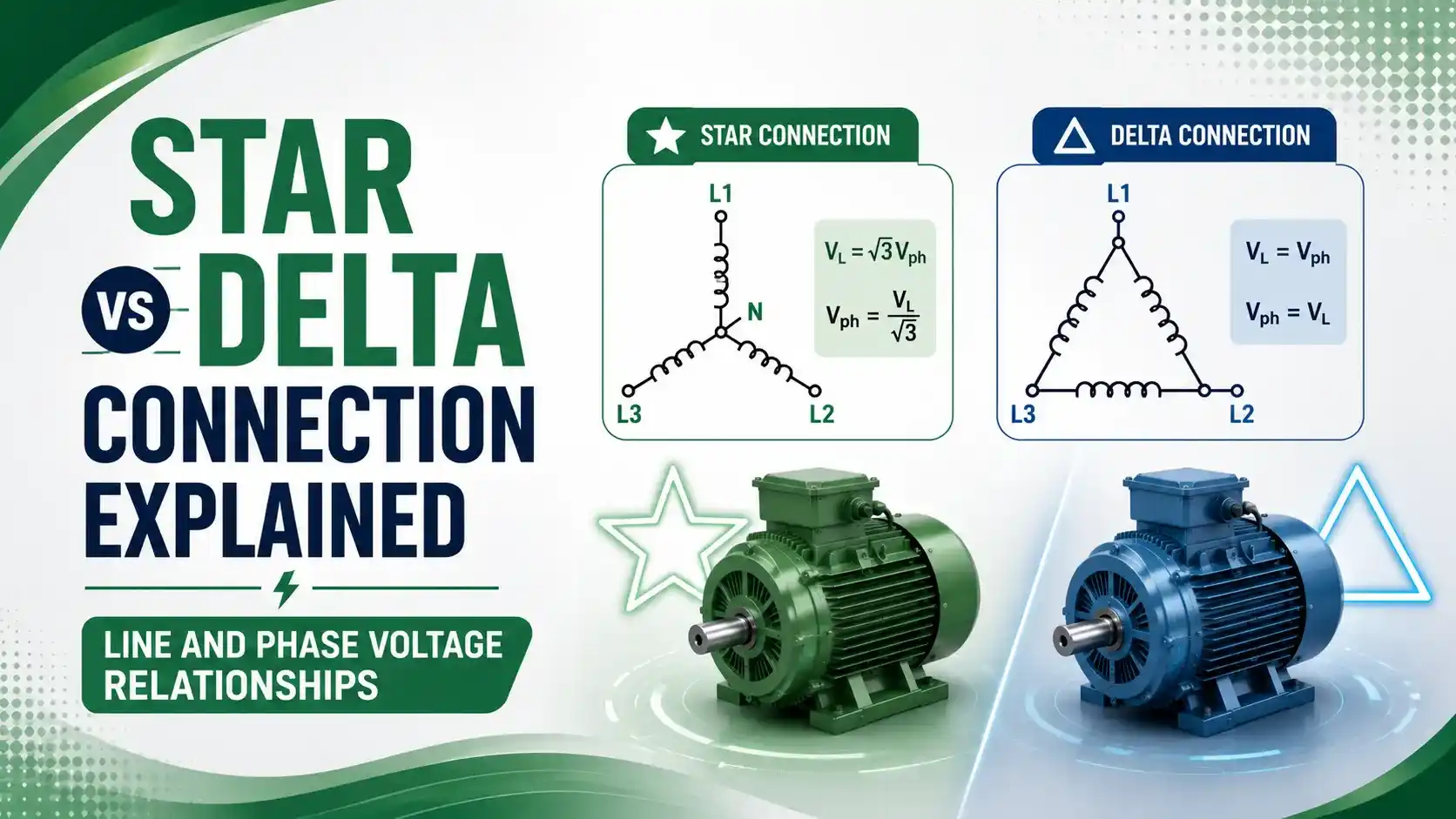
This wiring choice matters because it fundamentally changes the relationship between line voltage (measured between any two line conductors) and phase voltage (measured across a single winding), which is central to sizing motor starters, transformers, and generators correctly.
Real Life Example
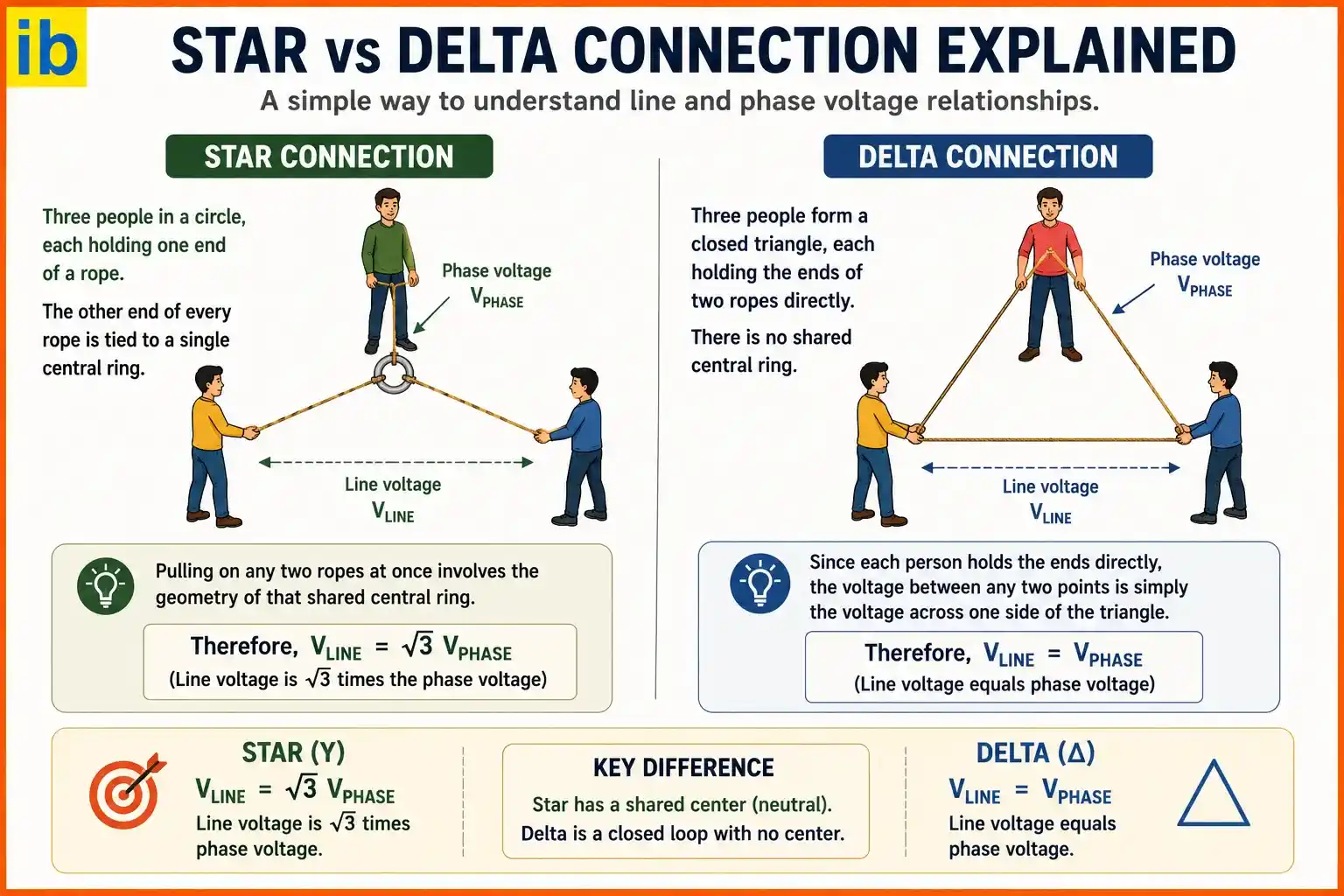
Think of star connection like three people standing in a circle, each holding one end of a rope while the other end of every rope is tied to a single central ring in the middle. Pulling on any two ropes at once involves the geometry of that shared central ring, which is exactly why the voltage between any two lines in a star system works out to √3 times a single rope's own tension, not simply double it. A delta connection is more like three people forming a closed triangle, each holding the ends of two ropes directly, with no shared central ring at all, so the voltage between any two points is simply the voltage across one side of the triangle.
Star vs Delta: Voltage and Current Relationships
Star connection joins all three windings at one central neutral point. Delta connection wires the windings end-to-end into a closed triangular loop, with no neutral point.
Formulas
This is exactly why common low-voltage distribution systems, like 230V phase to 400V line, are star connected: a single system delivers both a lower single-phase voltage (phase to neutral) for standard loads and a higher three-phase voltage (line to line) for larger equipment, from the same supply.
Comparison Table
| Feature | Star (Wye) | Delta |
|---|---|---|
| Wire Count | 4 (3 lines + neutral) | 3 (no neutral) |
| Line Voltage | √3 × Phase Voltage | Equal to Phase Voltage |
| Line Current | Equal to Phase Current | √3 × Phase Current |
| Neutral Available | Yes | No |
| Resilience to Winding Failure | Generally cannot continue on 2 phases | Can continue at reduced capacity |
| Typical Use | Distribution needing dual voltage, low voltage generation | Motor windings, transmission, harmonic suppression |
Applications
Residential/Commercial Distribution
Star connection supplies both single-phase (phase-neutral) and three-phase loads from one source.
Motor Windings
Motors run permanently in delta, or start in star and switch to delta for reduced inrush current.
Transformer Connections
Star-delta and delta-star transformer configurations balance voltage transformation with grounding needs.
High Voltage Transmission
Delta connections avoid needing a neutral conductor over long transmission distances.
Generator Windings
Generators use star connection when a neutral ground reference point is required for protection.
Harmonic Suppression
Delta windings trap and suppress triplen (3rd order) harmonic currents from circulating onto the supply.
Star vs Delta Connection: Video Walkthrough
Frequently Asked Questions About Star and Delta Connections
- Electronics Hub, Difference Between Star and Delta Connection
- All About Circuits, Three-Phase Y and Delta Configurations
- The Electrical Guy, Star and Delta Connection Explained
What We Learn Today
- Star connection joins all three windings at a common neutral point, forming a 4-wire system
- Delta connection wires windings end-to-end in a closed loop, forming a 3-wire system with no neutral
- In star, line voltage is √3 times phase voltage; in delta, they're equal, with the current relationship reversed
- Star provides dual voltage (phase-neutral and line-line) from one source; delta is more resilient to single winding failure
- The √3 voltage reduction in star configuration is exactly why Star-Delta motor starting reduces inrush current